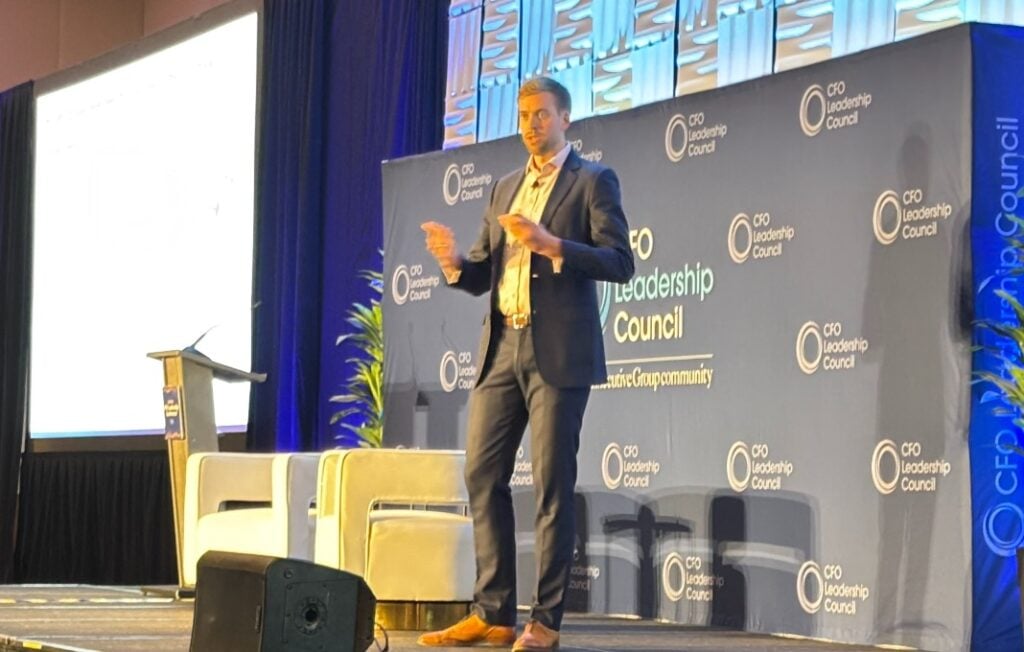
As CFO of Protos Security, Anthony Escamilla oversees the financial infrastructure behind one of the nation’s largest security services networks.
That responsibility extends far beyond traditional accounting and reporting, encompassing provider performance, operational controls, technology investments. Rather than directly employing all of its guards, Protos Security manages and coordinates thousands of local owner-operator security vendors, adding labor volatility in a highly distributed workforce into the mix.
In conversation with CFO Leadership, Escamilla shares how he thinks about hidden cost drivers, the metrics that matter most in a third-party provider network and what financial readiness looks like as Protos continues to expand under private equity ownership.
From a CFO perspective, where do companies in this industry most often miscalculate the true cost of delivering these programs at scale?
I believe that the complexity comes from the fact that the cost to deliver these programs is not limited to the hourly wage on a post. At scale, margins are most often eroded by miscalculating indirect and variable costs that compound quickly across thousands of shifts and locations.
The most common pressure points include labor volatility due to overtime, backfill and last-minute call-offs, compliance and credentialing costs, regional wage differentials and the operational overhead required to recruit, onboard, schedule and supervise a highly distributed workforce. Many operators also underestimate the cost-of-service failures for things like open posts, inconsistent performance or provider churn. Failure to take these things into consideration often drives rework, client dissatisfaction and ultimately margin leakage.
In addition, programs that rely on heavy fixed infrastructure often struggle to remain profitable as client demand shifts by geography, time of day or risk profile. Without the ability to flex capacity efficiently, costs can quickly outpace revenue. Sustained profitability in guarding and off-duty services requires disciplined cost visibility, scalable operating models and the ability to adapt quickly as client needs evolve without sacrificing service quality.
Protos orchestrates a vast network of third-party security providers rather than employing a single monolithic workforce. What financial controls and performance metrics are essential to making that model sustainable?
A distributed third-party managed services model only works when strong financial and operational discipline is paired with an uncompromising focus on the client experience. Sustainability is not driven by controls alone, it’s driven by delivering reliable, compliant, high-quality service at scale.
From my perspective as Protos’ CFO, that means having clear visibility into pricing, fulfillment and true service-level economics, while ensuring our provider network is aligned with the outcomes our clients expect. That being said, cost is only a part of the equation. Metrics like on-time fulfillment, network compliance, billing accuracy and issue resolution directly impact retention, pricing power and long-term value.
Because we demand high performance, we’ve invested heavily in data quality and transparent reporting. That visibility allows our vendor partners to understand their performance in real time and make adjustments before issues escalate. The result is fewer open posts, more consistent service and less disruption for clients while still driving strong returns for Protos.
Ultimately, our model is sustainable because the incentives are aligned. Providers are rewarded not just for efficiency, but for consistently delivering the best-in-class client experience that defines Protos. It’s that alignment allows us to scale responsibly while protecting quality, trust and profitability.
As Protos grows under private equity ownership, what does “financial readiness” look like for the next phase of the company, whether that’s expansion, acquisition or a future liquidity event?
Financial readiness at Protos means being able to scale, transact and/or exit without having to fundamentally change how we run the business. Under private equity ownership, in my experience that starts with having a finance organization and infrastructure that produce timely, accurate and decision-ready information every week and month, not just at quarter end or during a transaction process.
I partnered closely with our equity sponsor during its investment thesis stage, before Protos became the platform upon which we built the business. That early collaboration shaped how I thought about scale, integration and value creation from the outset. From day one following our sponsor’s initial investment, everything we’ve done within the finance organization has been intentionally designed to support a successful outcome for our shareholders.
A critical part of that readiness is talent. I’m very focused on hiring—and retaining—the right people with the right mindset and personality, not just technical capability. The teams I lead across finance, accounting, information technology, legal, real estate and facilities, data intelligence, mergers and acquisitions, and enterprise risk management are the strongest teams I’ve worked with in my career. They think like owners, they move with urgency, and they always understand how their decisions impact clients, risk, colleagues and long-term enterprise value.
Practically, financial readiness also means strong service-level economics, disciplined forecasting and a clear understanding of what drives margin, cash flow and returns across clients, services, response types and markets. It means clean books, well documented processes and controls that stand up to diligence whether we’re evaluating a buy-side opportunity, integrating or rolling out a new platform, or preparing for a future liquidity event.
Ultimately, I’ve always believed that financial readiness creates optionality. In my current role, it positions Protos to pursue organic expansion, execute on our acquisition strategy or enter a liquidity process from a position of strength with credibility, transparency and confidence in the underlying business.
Protos oversees the largest off-duty law enforcement network in the U.S. From a CFO’s seat, what are the biggest financial and operational risks in orchestrating that scale and how do you engineer controls without slowing the business down?
At Protos, our third-party and off-duty law enforcement networks, combined with our proprietary tech stack, are the foundation of our business and a key differentiator. The biggest risks at that scale are loss of visibility, inconsistent execution and compliance exposure across jurisdictions.
From my seat, the solution is not more bureaucracy but rather better design. We invest heavily in selecting and continuously vetting providers, and we embed financial, operational and compliance controls directly into our technology and workflows. That gives us real-time visibility into performance, fulfillment and margins without slowing the business down.
By pairing disciplined provider management with data-driven decision making, we’re able to scale a highly distributed network, maintain and protect competitive margins, and deliver consistent client outcomes. My goal has always been to make controls an enabler of growth, not a constraint.