
There are few—if any—technology revolutions in history that moved as fast as the one we’re in right now, and few parts of business are feeling the impact quite as acutely as the finance function. CFOs are not only rebuilding their own operations for an AI-centric, agentic, how-do-we-really-trust-it world, but also guiding the rollout everywhere else in their companies.
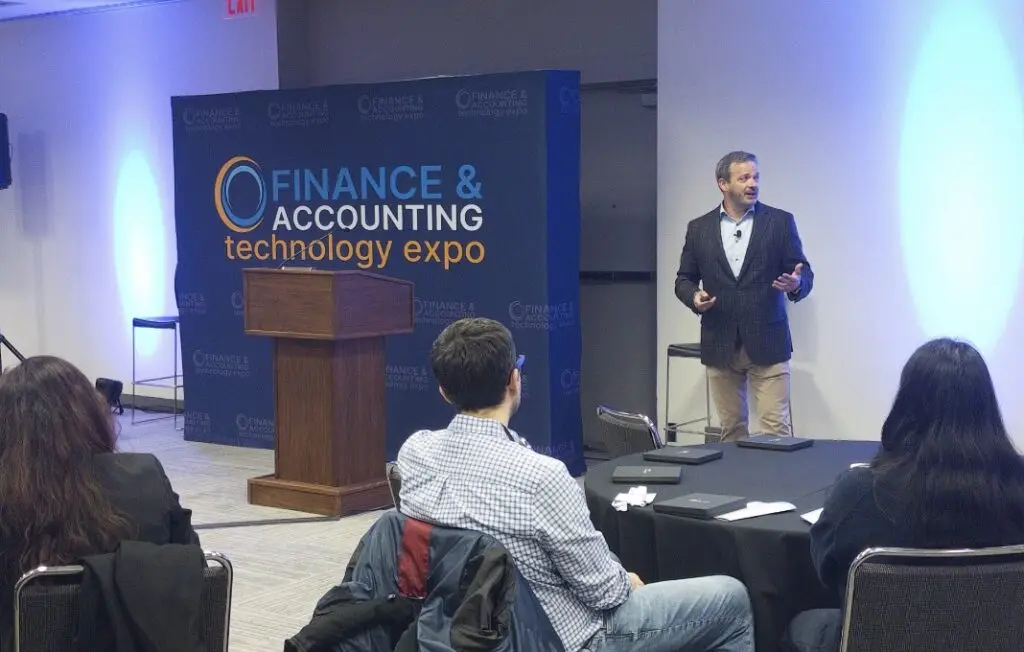
The result was on vivid display at this year’s Finance & Accounting Technology Expo at the Javits Center in New York. Now in its third year, it was a circus of new ideas, vendors—many born in just the last year or two—and thousands of attendees from across the country piling in for a sense of where the future was headed, and how to navigate it.
And while the vibe was a bit more surefooted and confident than in past years—to a person, everyone was using AI or AI-enabled software in some way—enormous questions still loomed: What can it do? What can’t it do? What will my people need to do? What is all this going to cost and can we really afford it? And, against the backdrop of a string of massive computer failures across the world, how can I secure it? Here are five novel and of-the-moment pro tips and to-dos gleaned from a very busy week in New York:
Insure All Insurance. At a pre-event conference, Kelly Slavitt, chief legal officer at Rectangle Health cautioned that when it comes to cybersecurity and cyber insurance, it isn’t enough to have your own. They’re pursuing a claim after a major vendor was hit by ransomware. The vendor had let its contractually required cyber insurance lapse and never said a word. “We required it of our vendor, and yet they didn’t have it. And yet they didn’t tell us. So are they in breach? Of course they’re in breach. But by the time we sue them two years later, this company’s gonna be out of business.”
Six Sigma Your Agents. When it comes to the agentic future of business, the key to management may lie in the not-so-distant past, at least according to Michelle Beyo, author of Mastering the Future of Finance. She said many companies—and managers—still fail to understand that AI-powered agents are much more like employees than software. Luckily, she said, we know how to handle employees. She councils pulling your old six sigma continual improvement handbooks off the shelf as a great way to build a framework for overseeing agentic work.
Use AI for Data Health. We all know that clean—or cleanish—data is the key to making AI sing. But getting there can be a brutal, endless, expensive and all-too-manual process. Tom Kelly from Oracle NetSuite shared a great pro tip: Rather than ask AI to do the work—with the expected sloppy results—instead let it guide your humans to a more-targeted, efficient cleanup. Set it free to look over your sales info, for instance, pointing out duplicated addresses, order numbers and so on, then have it create punch lists for your team, making them far more effective than doing it alone.
Measure ‘Agentic Leverage.’ In the hunt for AI ROI, useful metrics that point the way remain scarce and can vary wildly by department—and manager. Dmitry Vedenyapin and Saurabh Chauhan from PeakFlo shared a simple way to cut through the noise and normalize across the business. They call it “agentic leverage”: hours of agentic work divided by hours of human review, oversight and approval. It may not be perfect, but it sure beats token spend as a measurement tool.
Test For Real Value. When you’re looking to modernize and deploy AI in your finance shop, start with the work not the tools. But how? Emelie Smith from Unit4 offered a simple, four-part framework: 1. Eliminate. Ask: Should this step exist at all? Ie: duplicate entry, redundant review. 2. Standardize. Can one rule replace many workarounds? Ie: one intake route, approval thresholds. 3. Automate. Can the system act when conditions are clear? Ie: invoice capture, matching. 4. Augment. Where does a person still need help deciding? Ie: coding suggestions, exception context.
So what kind of process should we be tackling? How do we know what needs an overhaul? Cecile Dinh of Velosio had a great rule of thumb: “An outdated process becomes normal when we stop asking, ‘Why do we do it this way?’”