The volatility in Washington is showing up in corporate finance departments.
CFO Leadership’s Q1 CFO Confidence Index, conducted among 195 U.S. CFOs January 19-21, unfolded as President Trump warned of higher tariffs on the European Union and later announced a deal framework with NATO allies.
Sentiment shifted sharply in real time. The 130 CFOs polled before the deal announcement rated current business conditions 5.5 out of 10, a 9 percent decline from the 6.0 rating CFOs offered in Q4. The 60 CFOs polled after the announcement, however, reported a brighter perspective, rating conditions 5.9 out of 10, a 9 percent turnaround in less than 24 hours—recouping almost all of the earlier losses.
When asked to forecast conditions for the year ahead, the first group expressed pessimism about potential improvements, forecasting business conditions would deteriorate slightly in 2026 to end the year at 5.4. The second group instead showed optimism, albeit cautiously, forecasting conditions would improve to 6 out of 10—a difference in rating of 11 percent compared to the first group.

While the second group provided some upside to the overall Index for the first quarter of 2026, it wasn’t enough to completely reverse course.
Overall, CFOs’ assessment of current business conditions is now 5.6 /10, still down from Q4 (-7 percent). CFOs’ expectations for the conditions by this time next year also landed at 5.6, down 10 percent from last quarter’s 6.3—indicating that despite the uptick at the end of the polling window, CFOs are still not expecting business conditions in 2026 to take a much different turn than in 2025.

THE POLITICAL INFLUENCE
The political (and geopolitical) environment is playing a significant role in how CFOs and leadership teams approach growth and risk—and as a result, investments and hiring. CFOs shared how policy shifts emanating from Washington—from tariffs to regulations to what one called “the Greenland madness”—is impacting their planning and creating challenges for business.
“The fundamentals of the economy seem to be good,” said one CFO among the most positive in the survey—adding: “Geopolitics, however, is a giant mess.”
“The markets can contend with only so much,” said another.
“Inconsistent, volatile and unpredictable actions from U.S. government/president makes it hard for businesses to operate,” said another, echoing a common sentiment.
One CFO explained: “Tariff uncertainty, including upcoming Supreme Court decision on IEPA tariffs. Trump administration uncertainty re tariffs, foreign policy and disruption to historical gov’t structures i.e., the Fed. All this impacts economic outlooks, investment, employment, consumer spending.”
That uncertainty is reflected in CFOs’ 2026 forecasts for their respective organizations:
- 73 percent forecast revenue to increase in 2026 (down from 76 percent in Q4)
- 56 percent expect profits to increase this year (down from 69 percent in Q4)
- 38 percent plan to increase capex this year (down from 45 percent in Q4)
The findings contrast with CEOs telling Chief Executive, our sister publication, that their top priority this year is to increase profitability.
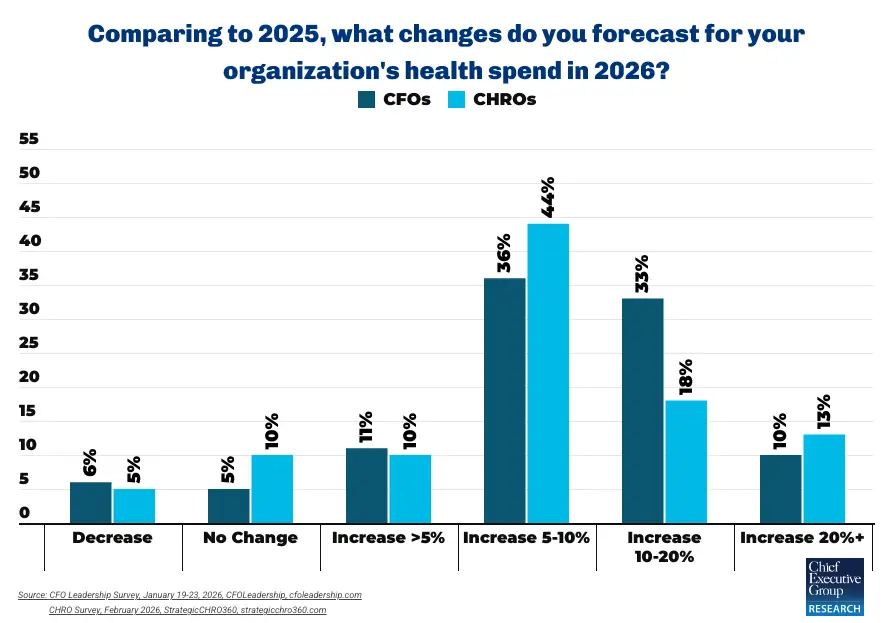
One factor impacting profitability, polled CFOs reported, is the rising cost of healthcare. Ninety percent of respondents say their healthcare spend is increasing in 2026, with one-third saying their cost has increased by 10 to 20 percent year over year.
One positive sign: 44 percent of CFOs say they plan to add to their headcount in 2026, up from 41 percent in Q4.