The race to install artificial intelligence in nearly every aspect of business is on, and no part of business is more hopeful for a hand than the finance function, where centuries of manual and semi-manual human effort have crashed into a longstanding labor shortage that shows no sign of abating.
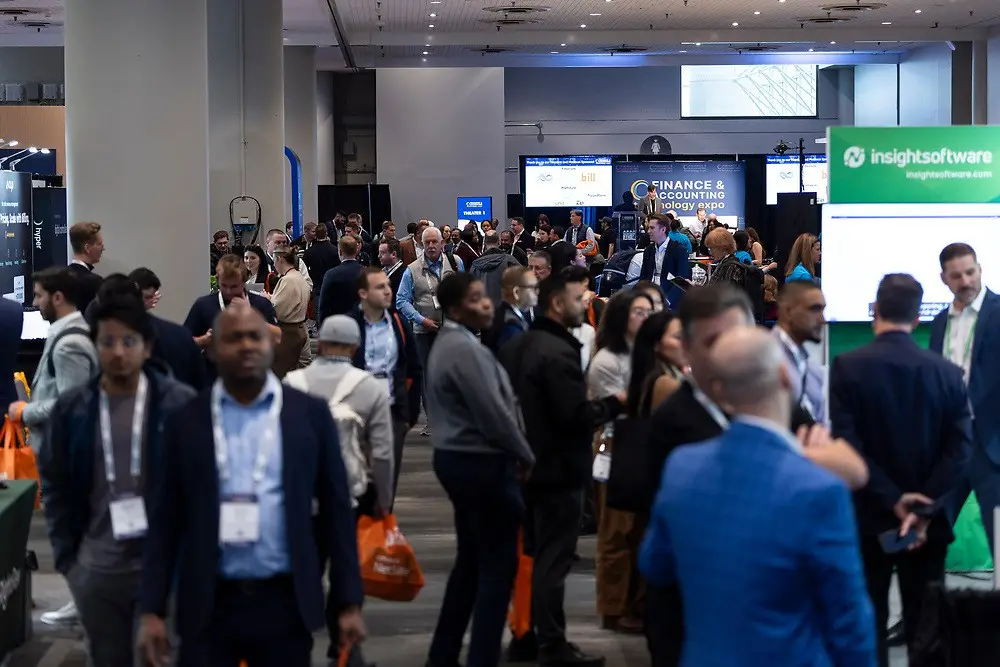
That promise made for a giddy, gold rush atmosphere on the floor of the Jacob Javits convention center on the West Side of Manhattan this week as nearly 2,000 attendees mobbed two football-field sized pavilions crammed with vendors for CFO Leadership’s 2nd annual Finance & Accounting Technology Expo.
The fact that FATE more than doubled in size in just a single year, and looks to double again in 2026, tells you all you need to know about the demand to sort out what technology vendors are the right fit for their finance shop and their challenges. As every CFO who’s ever replaced an ERP will tell you, software commitments in finance are akin to getting married in a state with 18th century divorce laws—software swaps are not for the faint of heart.
Here are a few takeaways from the floor of FATE and the AI for Finance workshop this week:
AI comes of age. While the great agentic future we’ve all been promised is still more a work in progress than many vendors would like to acknowledge, it will likely happen in 2026. I spoke to a number of CFOs at mid-market companies who had deployed AI-supplemented workflows in 2025, sometimes generative-AI versions of robotic process automation-type projects that helped with closes and reconciliations, but with more flexibility and adaptability.
Trust grows. The adaptation of this kind of innovation—at all—speaks to a much bigger and more important trend on display at FATE: The overall vibe change around the fundamental question of whether or not AI is or will ever become good enough and predictable enough to use for financial data.
Cliches of the week. If 6-7 is on endless repeat among middle-school muddles, the recent MIT study that found 95 percent of all AI pilot projects thus far have had no measurable impact on profit and loss, and “AI is only going to get better from here” win for “most said” at FATE, speaking to both the nascency and the optimism of AI’s early innings.
New entrants vs. established giants. As AI-native ERPs like newcomer Campfire threaten to disrupt this cornerstone of all business software, offering the promise of a smarter, streamlined, out-of-the box experience, the biggest question at FATE was whether big incumbents would pivot quickly to retain their enormous installed user base by rolling out new features. The jury is still out but given the costs and challenges of making switches like this, it’s up to big players to prove whether they will become the Netflix of finance tech—or the Blockbuster Video.
Actual agents. As everyone reading this likely knows, unlike traditional software like Excel, for instance, generative AI is fundamentally not deterministic—it is probabilistic—leaving folks who need $1,000 in paid revenue to remain at $1,000 no matter where it goes in the record-keeping and analysis process wrestling with oddball changes and less-than-auditable outcomes. That’s changing fast—many vendors are cracking the code by mixing deterministic workflows with generative and/or agentic “layers,” leaning into the strength of each.
It’s happening. At AWS, for instance, Lindsay Drake, CFO/vice president, finance for AWS Applied AI Solutions, has created a number of in-house finance agents, including one called Neo that has reduced 15-minute reconciliations for some 35,000 instances to a single minute, and the four-plus hours it normally takes to run down anomalies to 15 minutes. They have even more ambitious projects ahead, she told attendees at our AI in Finance Forum. They pull all their numbers into a database with more traditional methods and allow their generative AI to pull data and help analyze it. Period. “They are not allowed to do calculations, they are not good at calculations,” she said. “We do not want the LLM getting creative.”
Data remains the core. None of this is possible, of course, without clean data. That remains the alpha and omega for any potential technology advance in the finance shop. For big companies, and ambitious mid-sized companies, that means hiring data engineers to bring order. For smaller companies, it likely means a company like startup Preql, which helps make sense of your disparate feeds so, as CEO and Co-founder Gabi Steele said at the AI in Finance Forum, revenue remains revenue. “The single-source-of-truth problem remains unsolved, but I believe it will be,” she said. “And you can be the leaders of that.”
CFO Leadership can help. Even with all these cool technology advances, finance technology remains a big challenge. To help, the CFO Leadership Council and Duke Executive Education (a unit within Duke University’s Fuqua School of Business) announced a strategic collaboration at the event to launch a new Finance & Accounting Technology Certificate.
The certificate program, comprised of 10 virtual modules, will include deep dives led by expert Duke faculty, providing an academically rigorous and practice–forward learning experience. Other modules draw on CFO Leadership Council’s peer-driven insights and industry-relevant content. Learn more about the program >