For Charly Kevers, each step in his career journey has been building to his current role as CFO of Carta. After working for a number of large, public companies like Tesla, Salesforce and HP, Kevers was ready to take the reins in a leadership role. So when he was introduced to the founder of Carta almost 10 years ago—a small, privately-held software company that helps startups and investors manage company ownership, employee stock options, fundraising and equity records—he took a leap of faith.
“Every stage of the company was different and the needs were different,” says Kevers. “That’s frankly what’s been most exciting. I don’t feel like I’ve had the same job over the years. It’s really become a different job every year.”
In conversation with host Jack McCullough, Kevers shares what he’s learned over the years at Carta, and how the company is impacting private equity and venture capital. Listen by clicking below. The Q&A, lightly trimmed and edited for clarity, follows.
—
Listen to the podcast here
We have a really exciting guest, so I know you’re going to love this episode. Charly Kevers is the CFO of Carta. Carta, through a connected ecosystem of tools, links together the key players in private equity and venture from investors and LPs to their portfolio companies. Charly, welcome to the show.
Thanks for having me. I’m glad to be on.
I will admit, I wasn’t terribly familiar with your company before we met. I probably oversimplified things, but do you want to expand a little bit on what Carta’s mission is?
Absolutely. I’d be happy to. Carta started effectively helping private companies manage their ownership. Think of it as digitizing stock certificates and enabling CFOs and founders to manage this through software and then build a full platform that helps with anything related to equity ownership. Think valuations, financial reporting, compliance, everything that helps you as a private company to do that.
In the last few years, we’ve extended that to help the investors that invest in those companies, so through this connect platform that you described now, helping the funds themselves to manage their back office and connect to the information coming from their portfolio companies, and then helping them then report to the LPs investing in those funds. What this means is for the funds, we’ve effectively created a purpose-built general ledger that effectively helps these CFOs at funds to manage their back office due to valuations, taxes, and capture the information from the portfolio company.
Again, a full platform that helps them in the private capital. The really important word that you use, Jack, is network. That’s really the main difference compared to a lot of software companies. You’ve probably thought through is just the fact that all of this is connected on one platform. What happens at the portfolio companies can be seen by the fund and can be seen by the LPs, assuming everybody’s okay with that information going through. That’s the big piece that makes us different.
It’s always great for me as a former CFO who works for a company, that is a product that I would be inclined to use. That’s terrific. I definitely want explore that a little bit. Before we do, I’d love to chat about your own background a little bit. Are you from Belgium?
I am from Belgium, yes.
To the best of my memory, and I’m almost 100 percent sure that you are our first guest from Belgium. Thanks for making a milestone happen. What was it like growing up in Belgium?
I loved it. I still love going back. I grew up in Belgium and France, so both are home for me now. My family is now in Paris, so I tend to go back to Paris more often than Brussels. What I’ve always found interesting in growing up in Belgium is that we’re not a very big country. Not that many of us in the world. The culture tends to be go and travel, go experience other countries, and then come back and basically explore other cultures to understand the world a bit more versus other countries.
France, for example, is a little more insular. They’re very open-minded, but tend to be a little more self-centered. That was input in my early life and then had a big impact on how I thought about my career and making sure I would work in different parts of the world to at least have that understanding before I chose to settle somewhere.
How long have you been in the States?
Almost 18 years.
There’s a bit of an accent there, but you’ve almost lost it completely. I had an uncle who moved from Ireland. I think he moved in 1928, and he died in like the early 1990s. He still had his accent. He used to joke, “I’ve only been here six decades, give me a chance.”
I’m trying the best I can, but there are definitely a few words and sentences where my accent will come up for sure.
If we talk long enough, I think my accent’s probably going to grate on people more than yours. Yours is at least a pleasant accent. Out of high school, you got your degree from ESC Business School and you have an MBA from INSEAD. Tell me, what about the young Charly made that an attractive educational path?
I happened to like numbers like a lot of finance people. I found that out early enough. I was just interested in the business side of things, hence why I went to the business school route. My family is not in the finance world, so I’m the first one go going down that path. ESC that happened to be one of the older schools in France. Again, one of the better ones.
Obviously, trying to go to the best school possible. It’s a great school to operate in France, in Europe. Not as well known outside of Europe and, at the time, outside of France, hence why then business school for me made sense to try to open up more opportunities to go work in other parts of the world and experience other opportunities.
You said it’s one of the oldest, but I believe I read somewhere along the way that it wasn’t the first, but it’s the oldest that’s still around.
I’ll double-check now, but you’re right. I think it is one of the oldest.
I think it’s older than this country. Is that possible? That would be like the early 1700s.
I thought it was late 1700s, so it’s probably a similar age to the US, but yes, it’s an old school.
How about that? That’s cool. When you were in Belgium, did young people typically work while they were students? If so, what was your first job?
I was too young to work when I was in Belgium. I moved to France when I was a teenager. My very first job was just delivering papers overnight to people in the neighborhood. Otherwise, we do a lot of internships in Europe. Before actually holding a real job after college, I had been doing an internship both in audits at Arthur Anderson when it still existed and in consulting. That gave me a quick understanding that audit wasn’t for me. I loved the experience. I learned a ton, but I didn’t want to do that for a living. That’s why I went the consulting route when I finished my undergrad degree.
Yeah, you and I are the same. I was with a firm. It’s now KPMG. It was Peat Marwick & Mitchell at the time. I loved auditing. The people were great. It was interesting work. I learned a ton in three years, but also, one of the things I learned is I didn’t want to do it, but it certainly, your first job was a paper boy because I was talking to my nieces and nephews and mentioned that I was a paper boy, and they didn’t actually know what the concept was. We called them paper boys.
No, it’s exactly what it was. Yes. I have two sons and was trying to talk about like summer jobs and these types of things, and they asked me, “What was your first summer job?” I explained, and they were like, “What do you mean delivering the paper?” Yes, they haven’t seen a newspaper in a long time.
“What’s a newspaper? Why would anyone need to deliver it?” I remember getting up and Sunday mornings in Boston, the paper was like that thick. It just I was a skinny little 11-year-old, so cool. Anyway, I want to talk about your career because I think you had a remarkable journey. Working in corporate development, investor relations with some of, I think it’s fair to say, some iconic companies like Lending Club, Salesforce and HP. Tell me a little about how all of these roles came together to prepare you for what ended up being your first CFO-type job.
Yeah, interestingly, I think every job I’ve had from the first one out of college to now all contributed to what I think has made me decently prepared to take the CFO role. Consulting and investment banking, the first two, really great foundations in terms of just how do you break down problems. How do you quickly ramp up on something new? How do you tell a narrative? How do you present things? Those very formative years, I really enjoyed it. At some point, I got tired of just being the person giving the advice and not doing anything.
As many folks in those situations, I was starting to wanting to get closer to the operations, corporate development. Interestingly, the learnings there were less about finance because the numbers is the easy part in M&A from my perspective. It gave me a much better appreciation for all the little things that operationally have to go right for these acquisitions and these transactions to be successful. The most important one being the people.
I had no appreciation for that as a banker, but then, as you get in the role of, “I need to support this new team coming in, make them successful,” the people side of it is, frankly, 80 percent of where the deal value gets created. That absolutely gave me a completely different perspective on how to approach just growing a business and scaling something. Investor relations is probably the most impactful part of my journey. I did not plan that at all. I was one of those, “You should try this,” and it’s a good experience and took the risk.
I learned a lot about how to communicate, how to interact with investors, of course, especially large public investors, not just private ones. I did it during a period of change, I would say. It was four different CEOs in two years at HP when I did that. You can imagine the types of discussions that would happen with external investors. That was quite interesting. High pressure, but high learning.
It’s interesting because it wasn’t that long ago, and I know a lot of CFOs, but I didn’t know any that grew up through the investor relations type of thing, like you did. You spent some time there. It strikes me now, it is obvious that it’s a good training ground for future CFOs, but do you think that’s going to be something more and more? The control has always been the farm system for CFOs, but are we going to see more people from IR?
I wouldn’t be surprised. I think it’s a position where you obviously need to know how to communicate that stable stakes, but also forces you to understand all the levers to a level of detail that you can then explain it in simple terms to investors. It’s not just the financials, of course. Investors start with what they can see, which is the financials, but always want to go behind it.
That’s true of any finance professional, but I think in IR in particular, you need to be able to talk about the go-to market motion and how people think about R&D and broadly, the investments the company’s doing and the strategy and connecting all that together. I think it’s critical to any CFO role and a great training ground to be able to communicate with investors, whether they’re private or public. Slightly different mindsets, of course, and understanding those nuances is important.
I recommend it highly but I wouldn’t have done it if somebody I respected highly had not told me, “This is the thing you need to do to really train you for something that, frankly, others don’t do. It would also differentiate you as a finance professional.” I didn’t come up the controller route. At the time, still a very important part of the skillset is do you understand accounting? Can you close the books and can you really be detailed on the technical aspects? This started to become more important. Yes, I do think you’ll see more people coming from that route.
When I talk to great CFOs and, look at what I do for a living, I talk to a fair amount of them, but a lot of them say the reason that they’re successful as a CFO is because they have a great accountant or a great controller or a chief accounting officer working for them. Each company, just what they need out of their CFO is different. There are multiple paths to get there.
I want to chat a little about your path just because of the companies you’ve worked for, and again, some great ones. Undoubtedly, you’ve had the opportunity to work with some brilliant people and probably had some really influential mentors along the way. I’d love to chat. Is there any, when you look back, it’s like, “I learned a lot from that person?”
I’ve been really lucky. Every experience, I had people I would consider as mentors who took the time to help me think through my career, what I could do to get better, to grow, to learn more. I think one of the most impactful ones was the person who was, when I was there at HP, running all of strategy and corporate development. That’s the person who came to me and say, “I think you should go try investor relations,” which was, at the time, not an easy path to go, and definitely not something I was thinking about. Not at all part of my career path. He was extremely influential. He was an ex-CFO and moved into more strategic roles and then eventually became the CEO of a company.
He was really good about pushing me in terms of, “Here are things you’re not thinking about. I know it stretches your limits, but this is how you’re going to grow. This is how you’re going to get better and learn more and learn from the best.” He was very influential in my career at that critical point where you start to build relationships that are important for long-term. Also, how to approach a business and how to think about it. Yeah, he was really impactful.
I’d love to chat with you about your experience with Carta. It is true this was your first official CFO role. Is that fair to say? What was it that attracted you to the opportunity? How did it come about?
I was at a stage of my career where I was trying to think a little bit about how can I continue to stretch myself and was looking, “Can I go make that jump to be the person leading a team.” Also, living in the Silicon Valley in the Bay Area, I’d never done a small private company. As you can tell from the track, it was all large public companies. I learned a ton from a lot of really smart people, but it was the time where I thought, “If I don’t do it now, I likely won’t do it.” I was already looking for a smaller company. I got introduced to the founder of Carta, Henry. The moment he explained what he was working on and the fact that it was a company building for finance professionals and generally finance, solving finance problems was really interesting.
I had experienced the challenge of broken cap tables as an M&A practitioner. I had an appreciation for what he was solving by building software to solve these problems. When he described the broader vision he had, it makes sense. “I would be excited to work on this, and whether it works or not, this is something I want to spend some time on. This feels motivating.”
What was really interesting is I got into really seriously considering the job. I looked at the numbers because, obviously, as any good finance person, I want to understand the metrics before I sign up for anything. I don’t think he understood how good the metrics were for the business where it was. It was Series B and the SaaS metrics were some of the best ones I’d ever seen.
Having been at Salesforce and reviewing a lot of SaaS companies from an M&A perspective, they were really good. All the net retention, the growth and the underlying customer metrics were really strong. I don’t think he understood how good they were. That, of course, also got me a lot more comfortable with the risk I was taking. There was still a lot of unknowns, but all of this combined made a ton of sense at the time.
I think it’s fair to say that it’s a very different company than the one you joined years ago. Of course, just what people expect out of CFOs is different than it was before. How is your role different than it was in the first couple of years?
The first couple of years were all operational and, frankly, firefighting as the company was growing extremely fast. Yeah, it was finance, but it was everything else. It is basically you play more of a business role because the two most important roles at the time were R&D and sales and everything else was getting invested too but it is secondary. My first job was to implement NetSuite. I’d never done that. Figuring that out was interesting.
Of course, getting the right accounting team in place was the first thing I did because I couldn’t have done it without great accounts on the team. It was a lot of how do you think about the right operational structure to support the growth of the business and to support decision making and understanding what’s happening? That was the first couple of years.
Now, we’re a much more complex business. We’re global. Most of my time is spent on working with our executive team on, “Where do we allocate capital? What tradeoffs do we make?” Tying all that to the strategy and spending a decent amount on strategy with our CEO and M&A. We’ve been lucky enough to be in a position where we can do M&A. That’s another area where I’ve spent more time in the last couple of years.
Over the years, I’ve spent a decent amount of time raising capital, so that also took a decent amount of time to do. We don’t have to do that anymore, given we’re not making money. Every stage of the company was different and the needs were different. That’s frankly what’s been most exciting. I don’t feel like I’ve had the same job over the years. It’s really become a different job every year.
There’s some statistic, I forget what firm it was, that CFOs change jobs every three years or so. It sounds like you change jobs almost more frequently, that it just happens to be in the same company.
That’s what it feels like. Absolutely.
You mentioned capital allocation. You also mentioned the relatively recent product evolution you’ve had expanding to the VCPE funds and it’s affiliated, but it is a new product roadmap there. Fundamentally, you’re still a financial guy. How do you balance the long-term growth plan? “We’re going to do this, it’s in our long-term best interest,” and the need to always be innovating and diversifying the products with fiscal prudence, which is a nice way of saying you’re probably cheap, Charly.
I am. I think that comes with the interest in numbers and finance in general. For us, it’s really the collaboration between our CEO and myself. There’s always, I think that, for us, that healthy tension where he’s always thinking two to three years out. He’s actually generally not too worried about this quarter and next quarter. He’ll want to know where we are and how the pipeline is evolving and all these things, of course. His mind is always two to three years out, which means he’s always thinking about what are the investments that we need to make to get to the specific roadmap items that he wants to reach. He’s then forcing me to be able to lay that out with the rest of the executive team.
The way we’ve made that work for us is by setting a three-year plan. That is generally how we operate. It’s very difficult in the software space to go beyond three. Everybody would like to do five to 10, but I don’t think it’s super realistic. We have that as the starting point, grounded and, in the strategy, of course. On an annual basis, to not have to debate every year what the budget should be and the short-term versus long-term because we’ve got a clear alignment across everyone and what the financial profiles should look like over the next two or three years.
We can set very clear constraints for every year. When we work, we’re starting to work on 26 right now, I already know roughly what the shape of the P&L should look like, which means we don’t have to greatly debate, “Here’s how much capital we have to allocate.” The biggest debate is more about where the pot of money is getting distributed, not how big the pot of money is. That’s made it much easier for us to operate because that is well established and how we operate. The debate is more about where to put it versus just we should spend more or less.
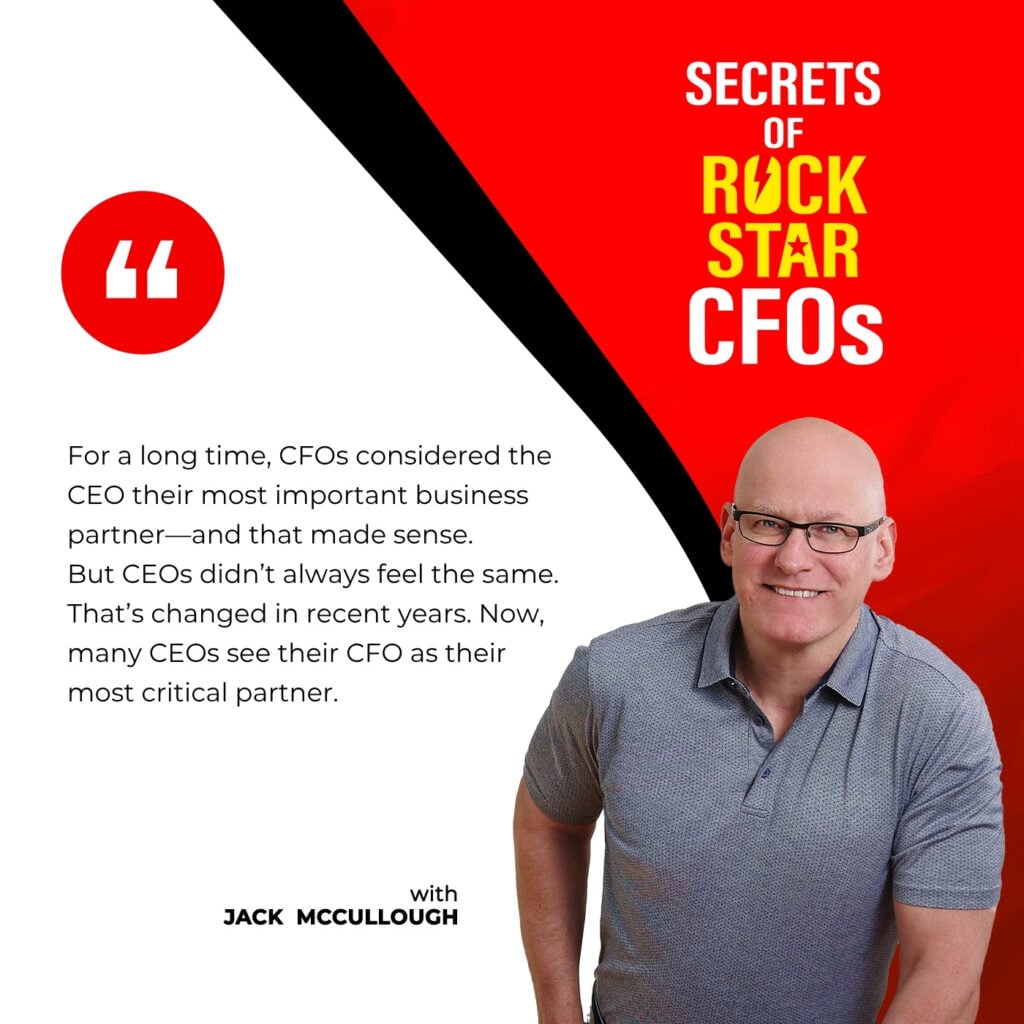
It’s interesting because you anticipated my next question perhaps, or at least a next question. One of the things I get asked a lot by the members is about the relationship between the CFO and the CEO. I’ve made the observation and people have said, “Yeah, now that you say it, that’s right.” CFOs for a long time have been saying the CEO’s their most important partner in their business life, and it made sense. The CEOs didn’t always reciprocate that and they didn’t even often reciprocate it.
I’d say in the last few years, and I don’t know if it’s the post-COVID world, things have changed or not, but CEOs are now identifying their CFO as their most important business partner, too, which must be great. I’m curious to get your perspective. Your CEO is Henry Ward, so you know how you build that partnership with him. The other twist on it is that Henry is one of the founders of the company, too, which puts some other dynamics in play as well, I suspect.
Founders that are a different breed for sure. I’ve learned a ton. If I think about the folks who have really pushed me and made me better, he’s one of those people because he is extremely curious, which means he wants to understand everything. That means if you say, “Here’s how we’re going to report and here’s how gap works,” he’ll ask questions. That means it forces me and my team to have very clear and thoughtful answers, and he can be, “Because this company does this. We’re just doing the same thing.”
From that standpoint, it’s made for a really productive relationship in terms of him showing a lot of interest. It all comes down, as I’m sure many of your guests have mentioned, to the trust and transparency between the two roles. I feel like I can say what’s truly on my mind, and he, of course, has no worries telling me what he thinks. It is really a two-way street. I think from day one, I’ve always felt like my voice was heard. That, to me, is really critical.
If I’m not in a position as someone who’s supposed to tell the truth, and I feel strongly that it’s my job is to tell everyone from our team to the board, “Here’s what’s happening, here’s what it means, and here’s what we’re going to do about it.” He is always allowed me to do that. He’s actually shown a lot of interest in understanding the financial perspective. Over time, he’s built his own perspective on what he wants the financial shape of the business to be. That respect and transparency has been key.
Yeah. It’s a beautiful thing. You are right. The founder CEOs, they just have a little different perspective on things. I say that as one so I can tell those jokes, I think, and get away with it a little bit. The other thing that I think is intriguing about your role within the company, not only the relationship with the CEO, but if I were on your company’s product development side, or certainly on your marketing side, I would be going to you all the time for any innovations in the company in the product roadmap. I’m just curious, are you involved in Carta’s product roadmap and do they seek you out and do you a Guinea pig to an extent?
Definitely a Guinea pig. We’ve tried a lot of features. It’s my team, broadly, and not just myself, of course, because some of the more detailed and technical features, my accounting team, for example, will be quite involved. We’ve tried a lot of things. I don’t know that they always love me having input on it because I can be pretty annoying on how I would like things to work. Part of what makes the job really interesting is I get to talk to the folks who are building the product and understand how they’re thinking about it, what other customers are saying, what we’re saying.
Yes, we spend a good amount of time, and especially when they have to do with feature supporting companies, private companies, we use all of them, as you can imagine, and always have a lot of feedback as well for our team. There this constant back and forth between our teams. I think it also actually makes life really more interesting for my finance team because they get to engage with the product. They get to engage with the R&D teams and see their process and see how they’re building and how they’re making decisions on what to build, what not to build. I think it’s also made for a more engaging experience for the finance team.
It’s interesting. They get annoyed with you. That’s like the people, those pesky customers. What a great company we’d have if the customers would just keep their opinions to themselves.
It would be so much easier, but not very interesting. The other thing that it’s allowed me to do being at a company where we serve, in many cases, CFOs and finance professionals, is that I’m more involved in talking to customers and go to events and hearing their thoughts. Partly because there’s just a bit of you’re a CFO, you get the types of challenges.
From a risk management standpoint, the complexity that we all deal with, the compliance requirements, everything that is making the job complex. That’s been tremendously helpful for me as well because I feel like I’ve been able to build my own perspective on what customers are saying and not just having to rely on what the teams are saying. I get to talk to folks directly and hear their pain points, what they like, what they don’t like. That’s just really useful input in everything we do.
Sometimes you can be there to translate. “What’s the CFO talking about?” You can help a little bit.
I definitely have many of these discussions where I’m like, “No. What they really mean is this.”
It’s cool that you have the opportunity to be involved in the sales and marketing type of process. Every company, and you’re not a gap CFO. You didn’t come up through, although you were in public accounting. You’re not like a controller who became a CFO. I’m guessing you communicate as you should through KPIs and other metrics. I’m just curious, what are some of your personal favorites to assess business performance?
I’m always trying to think of what are the few things that are as simple as possible that everybody can rely around. Growth is an obvious one. The one I particularly like is net dollar retention, just because it encompasses so many things in so many part of the business. It’s one number, but yet it’s a reflection of how happy our customers are, how good we are at building new things.
That’s one KPI we spend a good amount of time on and we communicate broadly to the whole company by different parts of the business. Looking at certain metrics on efficiency, magic number, rule of 40, these types of things, trying to keep it relatively simple but also being able to quickly point to everyone here’s why this matters, and here’s how everything connects together.
It’s amazing that you’re able to use those KPIs so effectively. One thing I want to ask you about, though, because it’s maybe the critical issue of our time, is how are CFOs using generative AI in their roles? We’ve been at a couple of years, there’s still a little bit of caution and uncertainty. What advice can you give people to embrace this truly a game-changing technology?
It feels like it’s changing every week, so it’s tough to keep up with everything that’s happening. For us, it’s a bit unique because we’re building that into the products. We have built it into the product. Part of what our team is doing is also very interesting to me because we’re solving accounting problems, for example. On the fund side, for example, we’re helping with cash reconciliations and building agents that can do that. It’s always very interesting to me and how it ended, it applies back to our team. We’re testing a few of the things our product team is releasing.
Similarly, we’ve done a lot around ingesting legal documents and making that information easily translating into the software. There are some use cases that makes sense for the broader G&A teams at Carta. We talk about finding specifically. The way we’re approaching it, and I strongly suggest that a lot of folks consider that every team that reports to me is identifying at least one use case a quarter that they need to automate with AI.
It can be really small to start with, but I’m basically being pretty annoying with my teams. I want everybody to use it. I want everybody to get at this stage and understanding what’s possible with it, and at least test how I can help their jobs. Of course, it’s looking all the high-volume tasks, very manual tasks, all the obvious components that you can manage. On the accounting side, we’ve already done for a few years using that for accounting memos and drafting a lot of the technical documentation. That’s already helped a good amount.
The team is piloting some recons that are still manual and it’s using LLMs to do that. It’s still testing phase, but starting to see some promising progress. My strategic finance team is using it to do variance analysis and also draft commentary to many of our presentations to at least have, based on all the information, “Here’s the commentary,” and just go tweak it versus starting from zero.
Most recently, we did something interesting is in an M&A process, we actually used it to feed a lot of the information we got from the target to identify what are the areas we should dig into. What are the areas of risk that based on everything you see and everything you know about Carta, you would advise us to go look at it? It was surprisingly good. We were able to run some analysis based on some of the finance data that we got. We’re basically, across the board, trying as many things as we can to identify ways to just get more efficient, get smarter faster so we can spend all our time on more complex analysis.
It’s amazing to live in an era that we live in with technology just constantly evolving. Aside from those types of changes, how do you see the nature of financial leadership and the CFO role in particular evolving in the years ahead?
One thing that’s already changed a lot and I think the pressure is only growing is, in my view, for finance professionals to really understand the operations of many other parts of the company. For example, in go to market, being able to engage with the CMO and CRO on how their pipeline behaves and which investments and top, middle, and bottom of the funnel will really maximize growth. Being able to be an active participant in those discussions and not just receiving the input, reflecting the numbers, and then moving on.
Similarly, on R&D, what does it mean to deploy new technologies and how does it impact the speed of developments where we invest? That broader pressure on you need to understand in more depth operationally and be more of a COO, really, in terms of your ability to engage with everyone else. I think that’s only going to continue to grow. The pressure’s on just communication.
Again, this is, I think, a topic you’ve talked a lot with many of your guests and I’m a very much on the same page. The requirements to be an effective communicator, to be able to take very complex topics and make them simple for the employees, for your peers, for the board, for investors is only going to become more important, especially in a world where change is even faster. Change is constant. Just being able to quickly get to a key message is critical.
That’s necessarily something that was true 10 years ago. Certainly, through my career, I’ve seen that change and I think it’s only accelerating. On technology beyond gen AI, I think just the CFO also has to be much more informed on how to think about systems and how to put a system architecture together, not just on the finance side, but be able to engage with all the other functions with a CIO. Basically, it is the systems, but maybe even more importantly, the data infrastructure and what that means in terms of your ability to then leverage AI and other pieces of technology that give you a sense of how the business is functioning.
That is something I absolutely underestimated, how much time I would spend on just the broader technology infrastructure. Even be before AI was something we all have to leverage, that was a much bigger part of being a CFO than I anticipated. I think that’s, again, only going to be become more important. You need to be a bit of a technologist now to be able to operate in this role because you need to be able to engage in those topics to make sure you get the data that allows you to do your job.
I think that’s a really insightful way of looking ahead to the future. I want to ask you just on a bit of a personal note. As CFO for a rapidly growing company in the Silicon Valley, I suspect you’re working quite a few hours and yet, I also suspect that you probably want to incorporate as much non-work things into your life. How do you do that? What’s your best path for achieving that work-life balance, which is so elusive to so many of us?
I don’t know if there’s ever like a great balance. I’m lucky enough that I like what I do, and so it’s never too difficult to focus on getting the job done. To me, it really comes down to just being disciplined around keeping specific time to do the things I want to do outside of work. For me, it’s one aspect is staying healthy and therefore, that means blocking enough time on my calendar. I’ve got specific workouts that I’m not missing and telling everybody, “Sorry, I’m not available at those times.”
Otherwise, as any CFO knows, there’s always something to work on. There’s always a crisis or a problem to go to go help with. It just starts with just discipline with myself but also with others and being clear that, yes, I’m carving out these times that I’m not available. I’m doing the same with my two boys, and in the evening. I’ve got a very clear slot where this is family time. Unless it’s super urgent, I’m generally not available. It’s being transparent around that. Many times, I’ve had to be available. Not to say it works every time, but it is just being clear with everyone else on the things you want to prioritize.
We can only do what we can do. You mentioned earlier that Belgium is a small country, so they encourage everybody to travel and see the world. Do you have any fun trips coming up that you can share with the audience?
I just came back from Paris, visiting family and actually going to my business school reunion. My wife and I met at the same business school, so it was easy decision to make to go back. We’re lucky enough to be able to travel a decent amount. Every year, we tend to go to Asia. My wife is from Korea, and so, we’ll generally go back there or in Japan or Europe. My son’s getting plenty of visibility to different parts of the world. We’ve done the fun trip for the summer. Now we’re back home.
You know where my fun trip was for the summer? In New Hampshire, and I live in Massachusetts, so you’re seeing a lot more of the world than I am. Good for you.
The U.S. is so large, there are so many beautiful places to see. What I enjoy about being here. I’ve been here for many years yet I feel like I’m still discovering so many parts of the U.S. that I didn’t know that are absolutely beautiful, so I’m sure it’s marvelous.
It’s such a big country. California is so different from New England. They’re both different from Texas and Montana. Cool. Anyway, I think you know I always like to ask my guests if there’s any advice for the next generation of CFOs that they’d like to pass on. Maybe people who are not quite at that CFO level, but six months, two years from now, they could see themselves in the role. How should they be thinking about that?
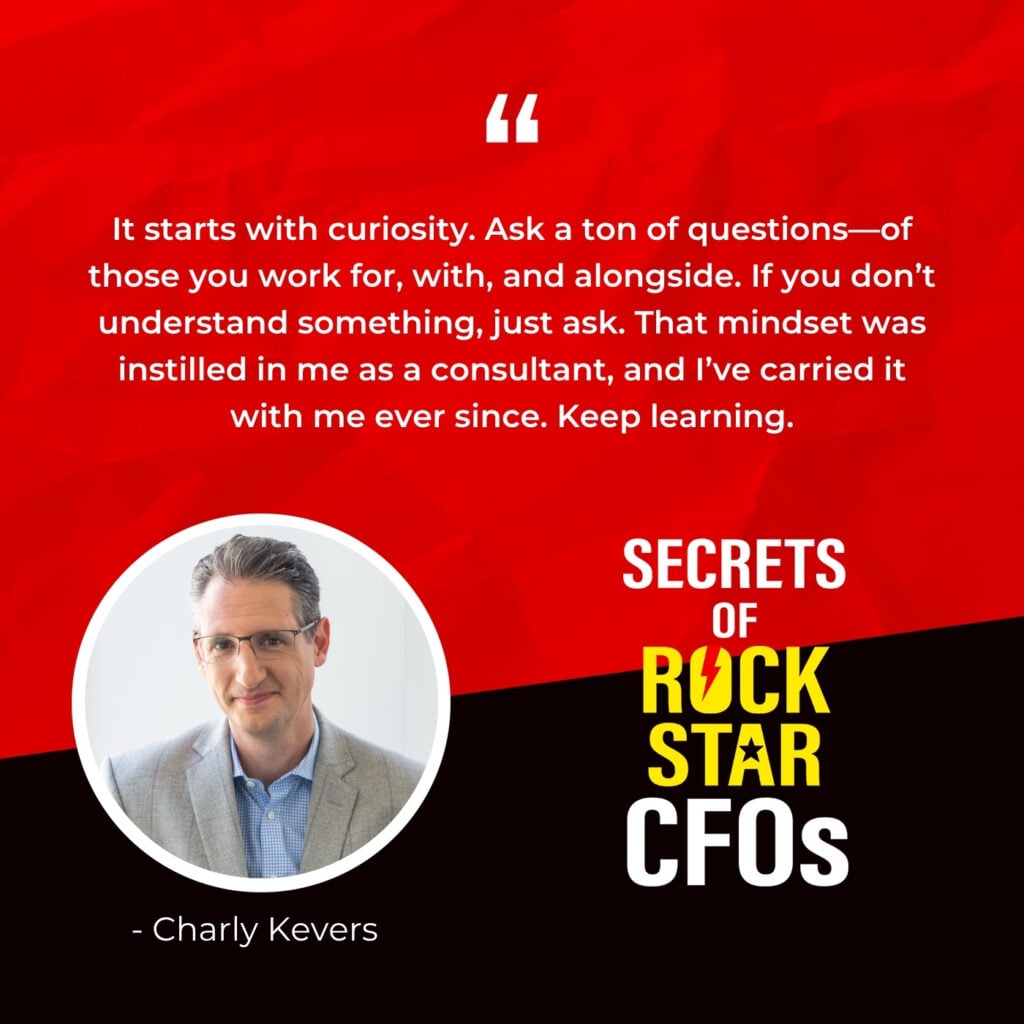
To me, it starts with being curious. Ask a ton of questions of the folks you work for, for the folks you work with, your peers. Ask as many questions as you can. If you don’t understand how something works, just ask. That was something that was really pushed on me as a consultant and that I’ve really tried to continue to do. Continue to learn.
The starting point is being curious. That then, to me, translates into, as you want to grow in your career, how do you start anticipating what the VP, the CFO, the board might ask when you look at financial numbers? Try to anticipate what the questions are. What are the follow-up questions? It pushes your thinking on, yeah, let me already anticipate these questions and, therefore, dig deeper in the problem so I already know three layers down all the details.
The last one in my mind that we’ve talked about is communication. Practice communicating to different groups, different constituents the information you’re working on. It can be a really small project. It doesn’t have to be something big and complex, but you’re really practicing being able to put together a narrative and explaining it. Get comfortable in different settings with folks who understand finance and folks who don’t, just to get a good feel for your style and really becoming comfortable in putting together a story with the numbers.
I think that is fantastic advice. Charly, I know you have a lot going on these days and probably in general, so I’m really grateful that you’re able to carve out some time to be with us. With that said, I’d just like to give you the final word.
Thank you. First, thank you so much for having me on. It was a really fun discussion and I appreciate you showing so much interest in all of us CFOs. It is good that we’re, we’re getting more visibility. I’m really excited for all the changes that are happening. The only thing I’d say to everybody reading who’s still early in their career is just say yes to the opportunities. Take a little more risk and learn as much as we can from others. Be as curious as you can. I think that’s where we all grow and we all get better when we do that.