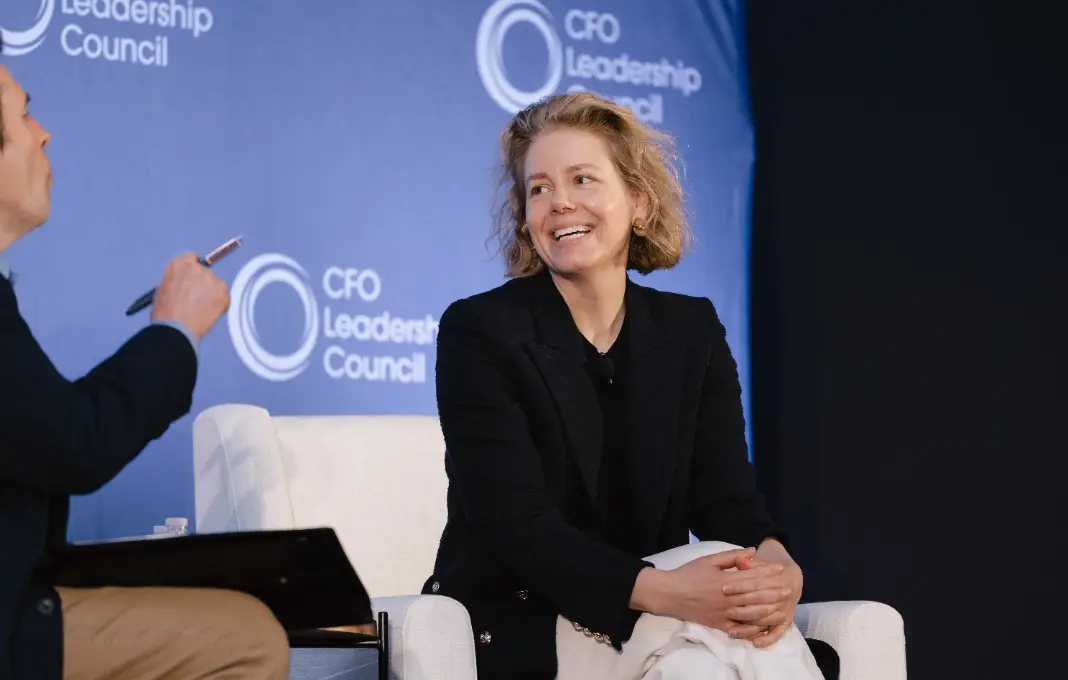
Kate Gulliver has been CFO of Wayfair for four years. But she’s effectively worked at five different companies—all under the same roof. There was the pre-IPO toddler, the hypergrowth rocket ship, the Covid boom, the post-Covid hangover and now the turnaround-into-growth story. Add in six years running the people function along the way, and you have one of the more unusual—and instructive—executive trajectories in American business.
At the CFO Leadership Council’s 2026 Spring Leadership Conference in Boston, she shared what she’s learned.
Survival clarifies everything. When Wayfair finally committed to getting profitable, every decision collapsed into a single question: Does this get us there? The absence of options turned out to be a leadership asset.
“We had no choice. It was a survival thing for the business. And I think in that sense, so many of us having been there for so long actually benefited the transition—because we all felt so strongly about the business and its ability to survive that we were really willing to do whatever it took. Everything went to that goal. And so that clarified very quickly decisions, because we knew we had to get there, we knew we had no choice, we had set a date that we had to get there by, and so every other decision that was made was in service of that one goal.”
Simple comp beats sophisticated comp. Wayfair ties nearly everyone’s compensation to overall business performance—not team or geography-level targets. It sounds counterintuitive, but Gulliver says it’s what makes rapid pivots possible—nobody fights to protect a target that’s being sunset.
“We’ve occasionally deviated from it and we’ve come back. Any time we’ve actually tried to do very team-specific objectives, that’s how they’re incentivized, we’re all actually incentivized on the ultimate same target. Most people do not want to keep in their head all the little different targets that they’re calibrated on. They want to work collectively. And we would not be able to make those pivots and changes if each team had their own objectives that they were compensated on separately.”
Finance belongs in the operation, not above it. Gulliver’s strategic finance team is so embedded in the business she jokes she sometimes can’t tell who they’re working for. Her advice to CFOs who want more influence: Go spend real time in an operating role.
“I always say go take a tour in business—run a small P&L or sit in an operational role somewhere, volunteer to go run a different part, a geographical region, something like that. Because your understanding of what’s actually feasible is significantly enhanced by having spent time in an operating role. When I was in consulting or private equity, I would recommend things and I think, oh my gosh, I really had no idea how hard operating was.”
Repeat the message until it’s boring. Then keep going. During the profitability push, Wayfair’s leadership hammered the same message for months. When someone finally asked if they could change it up, the answer was no, not yet.
Staying connected at every level of the organization—warehouse visits, store walkthroughs, time with junior staff—is what makes repetition land. “I think that the biggest thing, the piece that as senior leaders we tend to let go a little bit because our day-to-day lives are very busy—in addition to leadership delivering the message, it’s very important to actually be interacting and engaging with your frontline team.
“I meet with people from all over the company. I spend time with junior folks and mid-level folks. I love getting to talk to the interns. The more your leadership is engaged at all levels and all saying the same message, that can help drive that mission forward.”
On AI: the data cleanup remains the real work. Wayfair has used machine learning in pricing models for years. The shift to generative AI is newer, and the early wins have come where data is already clean—automated auditing of shipping expenses, for instance, where small errors across millions of transactions add up fast.
But Gulliver is candid about where the promise hasn’t yet materialized. “Where we have yet to see the gains is there’s a significant amount of data cleanup that across the business is still ongoing to then enable some of those early wins.” While there was a lot of promise at the very beginning that you could just dump it on a data lake and the AI was going figure that out, “we have not seen that yet.”
Choose roles for the people, not the title. Gulliver’s career advice cuts against most conventional thinking. She’s largely chosen her next move based on who she’d be working for—not the scope of the role or the title attached to it.
For CFOs, she narrows it further to two relationships that matter above all others. “I have largely chosen roles based on the people I have worked for, and very little to do with the title. For a CFO, the CEO relationship is the relationship—the second one probably being the board and the key members of the board that you engage with.
“I have been very fortunate to get to work with a wide range of folks,” she said. “But I was always choosing the role to get to work with them—less because of the role itself, but more for the opportunity to be partnered with them.”