
I recently joined a panel to discuss the AI Leaders Council’s 2026 Corporate AI Talent Study. As you’d expect, we talked about adoption rates, hiring plans, training gaps and the changing skills companies need.
But the most consequential finding wasn’t about how many companies have AI in production. It wasn’t even the percentage reducing headcount. It was this: 65 percent of respondents identified critical thinking and validation as one of the most important workforce skills in the AI era.
That sounds reassuring. After three years of breathless predictions about prompt engineers, companies have rediscovered judgment. Which is great, but at the same time, they’re increasingly automating the work through which people traditionally develop it.
We’re raising the bar while removing the ladder.
Deployment is outrunning preparation
About 56 percent of the organizations surveyed have AI operating in production. Yet only 37 percent provide formal AI training, and just 17 percent offer it company-wide. More than half say their employees are primarily teaching themselves.
What stood out to me in this stat is not that it’s a training statistic. For me that sounds like a controls statistic.
Self-directed learning has helped AI spread quickly, as many employees realized the power of this new technology well before corporate policies and programs caught up. They didn’t wait for a curriculum committee to teach them how to summarize a contract, write a variance narrative or troubleshoot an Excel formula. They opened a browser and figured it out. As a lifelong “citizen developer,” I think this is great (for the most part). Initiative is good, particularly when the alternative is another six-month software implementation.
But every self-taught workaround can become an undocumented process. In finance, that process could likely eventually feed a forecast, reconciliation, management report or journal entry.
I’m trying to tie this new tech to one that even slightly pre-dates me: The introduction of the spreadsheet. While software systems come from the top down, spreadsheets (like AI) were new tools put directly into the hands of employees, who figured out on their own how to use them.
The difference is that a rogue spreadsheet usually lives on a shared drive. (I know, it didn’t in the early days, but let’s jump forward to today!) A rogue AI workflow may live in somebody’s browser history, connected to a model that changes without notice and producing work nobody can completely reconstruct.
Another thought on the findings: In the early adoption era of generative AI, companies have measured AI access because access was easy to count. Far fewer measured whether employees could recognize when the tool was wrong, explain how an answer was produced or identify who owned catching the error.
I noted in the webinar that this is reminiscent of companies rewarding token maxxing, which seems like an odd metric to reward on in the abstract. Why are we measuring input, when what is really important is the output that comes from that massive token spend? I get it in this era of adoption: Companies were trying to incentivize employees to use the tools more. But ultimately, usage isn’t the goal. Output is.
The talent gap isn’t technical
If you asked most executives to picture an AI talent shortage, I suspect they’d envision engineers and data scientists, but surprisingly, that’s not what respondents identified in the study.
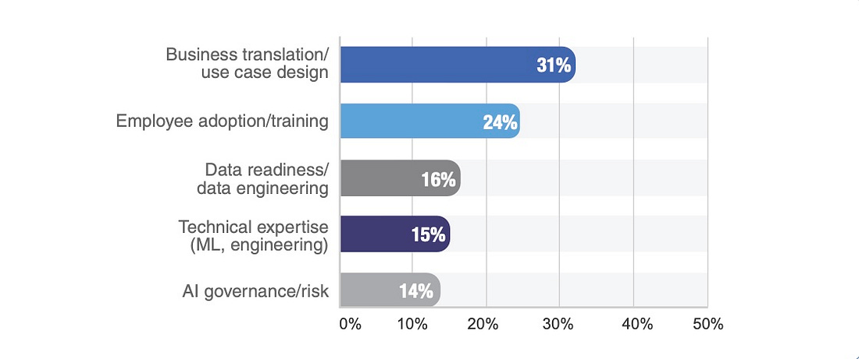
The largest talent gap identified was business translation and use-case design, cited by 31 percent of respondents. Employee adoption and training came next at 24 percent, followed by data readiness at 16 percent. Technical expertise came in at only 15 percent.
Honestly, this makes sense. If you think about it, “business translation” is the only item on that list that nobody clearly owns. Data has an owner. Technology has an owner. Governance should have an owner (although that one is often a little harder to locate). But who owns deciding which business problems are worth solving with AI? That responsibility tends to fall somewhere between the functional team that understands the work and the technical team that understands the tools.
A lot gets lost in the space between those two.
There’s another complication here. Much of the context AI needs has never been documented because companies have always relied on employees to remember it. Why an allocation works a certain way, which customer exception nobody touches, why one reconciliation always breaks after an acquisition or why the number in the system is technically correct but still isn’t the number management uses.
That knowledge lives in people’s heads, old emails, spreadsheet comments and processes held together by one employee who hasn’t taken a real vacation since 2017. Companies can’t simply connect AI to their data and expect it to understand the business. They first have to make their institutional knowledge legible. This is where I think finance has an advantage. The study found that critical thinking and validation were considered the most important AI-era skills, at 65 percent. These were followed closely by automation and workflow design at 61 percent. AI tool usage came in at 43 percent, while prompt engineering was selected by 33 percent. (More on that prompt engineering part later.)
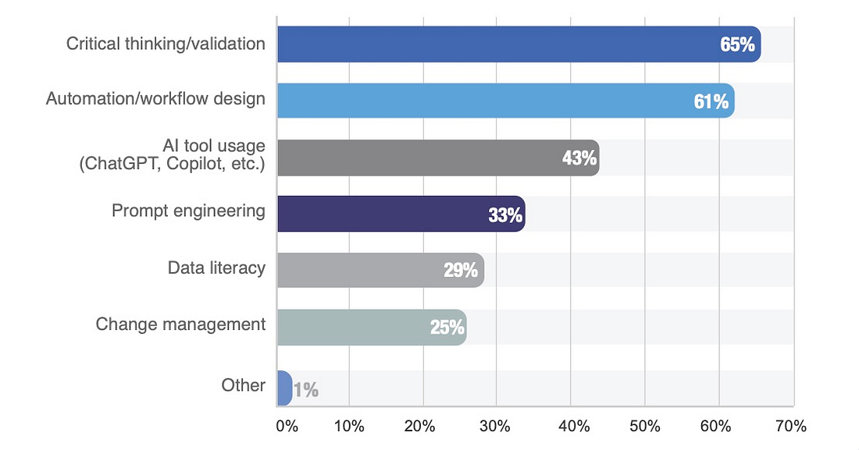
From a finance perspective, that list looks familiar. Critical thinking and validation are professional skepticism and materiality. Workflow design is process documentation and control design. Business translation is understanding how an operational event becomes a financial result.
That list is basically a description of the controller’s job!
This doesn’t mean every accountant is automatically prepared to lead an AI implementation. Finance professionals still need to understand what the technology can do, where it fails and how probabilistic systems differ from the deterministic software we’re accustomed to. But companies may be searching outside the organization for capabilities that already exist in-house.
The person who understands why a reconciliation exists, where it usually breaks and which difference deserves investigation may be more valuable to an AI project than someone who can write a beautifully engineered prompt but has no idea what the reconciliation is supposed to prove.
Companies aren’t hiring their way out of this
The study found that 73 percent of organizations aren’t currently hiring for any specialized AI roles. Only 12 percent are hiring AI or machine-learning engineers, 7 percent are hiring for AI governance and risk, and just 3 percent are hiring prompt engineers or AI specialists.
At the same time, 44 percent say upskilling existing employees is their primary AI talent strategy. Another 17 percent are combining upskilling with outside hiring. Only 4 percent are relying primarily on external AI talent.
I think this is what a technology skill looks like shortly after it stops being a standalone job. Companies don’t hire spreadsheet analysts anymore. Spreadsheet skills became part of nearly every professional role. AI appears to be heading in the same direction, only much faster and with a better press agent.
For large companies, that may mean adding a few specialized engineers, governance professionals and AI product leaders. In the middle market, a lot of that expertise will probably be bought as a service rather than added as permanent headcount. Either way, most employees won’t be replaced by a new department full of “AI people.” They’ll be expected to incorporate AI into the jobs they already have.
But saying “we’re going to upskill our people” isn’t much of a strategy by itself. You can’t upskill into a capability you haven’t defined.
Before buying training, companies need to document how work gets done, decide which parts a machine can own, determine where human review remains necessary and establish who is accountable when something goes wrong. Only then can they identify what employees actually need to learn.
Training gets purchased first because training is purchasable. Process redesign requires interviews, decisions and meetings where someone eventually asks who owns the thing. It’s much easier to give 5,000 people a prompt-engineering course and declare progress.
The likely result is 5,000 people who can write a prompt and a close process that runs exactly the way it ran in 2019.
The underlying workforce story
The headline labor numbers in the study are relatively measured. Fifty-one percent of respondents reported no significant workforce impact yet. Thirty-eight percent said AI is changing existing roles, while only 6 percent reported headcount reductions. Another 6 percent said AI is creating new roles.
The 6 percent reducing headcount will get most of the attention, but I think it may be the least interesting number in the group.
When respondents looked ahead two years, 33 percent expected AI to reduce hiring. Only 15 percent expected it to increase hiring. That suggests much of the near-term impact won’t arrive through large, announced layoffs. It will come through fewer backfills, smaller entry-level classes, slower team growth and existing employees absorbing more work.
Flat headcount plus business growth can produce the same future organization as a layoff. It just gets there without the fanfare and attention as layoffs.
For CFOs, this creates a new workforce-planning problem. Historical staffing ratios become less reliable when every budget assumes some undefined level of AI productivity. Open positions start being treated as automation opportunities. Teams are asked to absorb additional work because the technology should make them faster, even when nobody has redesigned the process or measured the actual capacity created.
The machines may not come for the accounting department, but they may well prevent the next accountant from being hired.
The apprenticeship problem
This brings me back to the study’s top-ranked skill: critical thinking and validation.
Where does judgment come from?
Nobody enters finance knowing which number looks wrong. We develop that instinct by preparing reconciliations, tracing transactions, investigating variances, building schedules, sitting through review notes and occasionally being confidently wrong in front of someone more experienced.
I learned materiality by getting it wrong under supervision. You can explain the definition in a classroom, but that isn’t the same as learning which discrepancy deserves another three hours and which one needs to be documented and left alone.
A lot of junior finance work isn’t particularly glamorous. But it creates context. It teaches people how transactions move through systems, how operating decisions show up in financial statements and how small errors become large ones. Eventually, pattern recognition begins to feel like intuition.
AI is particularly good at automating this kind of work, which can create real productivity gains (and I’m not arguing that we preserve manual reconciliations as some sort of accounting heritage project), but when we automate a developmental task, we have to figure out how to replace the learning it provided.
The study doesn’t tell us which jobs will be affected or whether junior roles will absorb most of the change; so I don’t want to make a claim the data doesn’t support. But the combination is hard to ignore: employers increasingly value judgment, AI is already changing existing roles and a third of companies expect it to reduce hiring.
Are we creating finance teams full of people expected to review work they were never trained to perform?
We’re automating the apprenticeship and then complaining that nobody has judgment. Again, we’re moving the bar and simultaneously taking away the ladder.
Rebuilding the ladder
The answer isn’t to slow down automation. It’s to redesign career development with the same attention we’re giving workflow design.
Junior professionals don’t need to manually process every transaction to understand the process. But they may need to investigate exceptions, trace AI errors back to source systems, document why a model failed and spend more time with the experienced employees who understand the business context behind the numbers.
They can learn to supervise automated work, but only if we give them a way to understand the work being supervised.
That means AI training needs to go well beyond product demonstrations and prompt libraries. Finance teams need role-specific instruction covering validation, data boundaries, documentation, escalation and accountability. They also need controlled opportunities to make mistakes before those mistakes reach the board deck.
Governance becomes even more important as companies move from chatbots that produce answers to agents that can perform actual tasks. A chatbot can recommend the wrong payment, but agents could actually initiate it. There’s a meaningful difference between giving an AI system access to intelligence and giving it authority to act … and that authority needs clear limits, approvals and audit trails.
The same discipline should apply to measurement. Token consumption, active users and prompt counts may help during an early adoption push, but they’re inputs. Eventually, companies have to measure the work itself: accuracy, cycle time, exception rates, forecast quality, decision speed and the amount of human verification required.
Build the business case around hours saved and eventually someone will ask where the headcount went. Build it around getting a defensible number sooner, improving the decision that follows or giving a constrained finance team more capacity, and the value is much easier to explain.
Who becomes the controller of 2036?
The report found that 52 percent of respondents expect more than 1/4 of their organization’s roles to be significantly affected by AI within two years. But even in that context, 1/3 have no defined AI talent strategy, only 37 percent provide formal training, and most employees are still learning on their own.
That’s a substantial amount of anticipated change resting on a fairly informal foundation.
I don’t read these findings as evidence of imminent mass unemployment. I see a more gradual redesign of jobs, hiring and expectations. That may be less dramatic than the layoffs dominating the headlines, but it could have deeper consequences for finance.
We should capture the efficiencies, automate repetitive work and use AI to produce better analysis, faster decisions and more defensible numbers. But we also have to preserve the machinery that creates experienced professionals.
Judgment is appreciating in the labor market while potentially depreciating inside the individual. Which one wins is ultimately a management decision.
The question isn’t simply whether finance departments get smaller. It’s whether we still produce anyone in 10 years who can look at a number and know it’s wrong before they know why.
The AI Leaders Council surveyed more than 300 North American executives between June and August 2026. The respondent group leaned heavily toward technology and AI leaders, with finance and accounting titles representing only 1 percent. I’ve treated the findings as a view from corporate AI leadership rather than a definitive survey of CFOs.