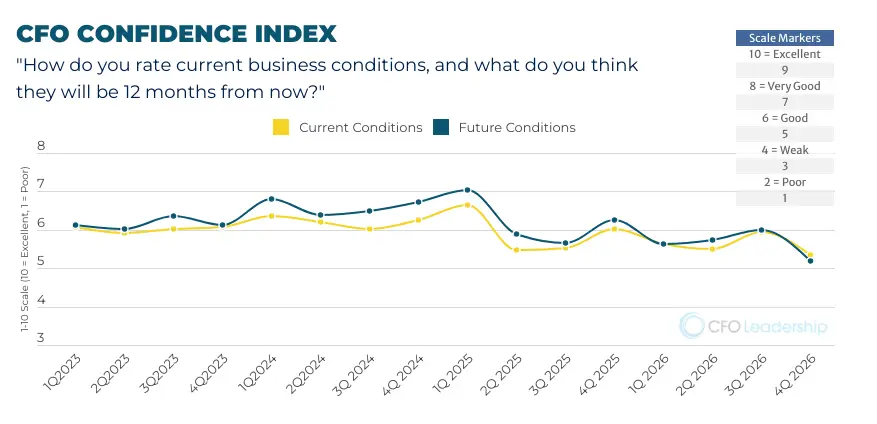
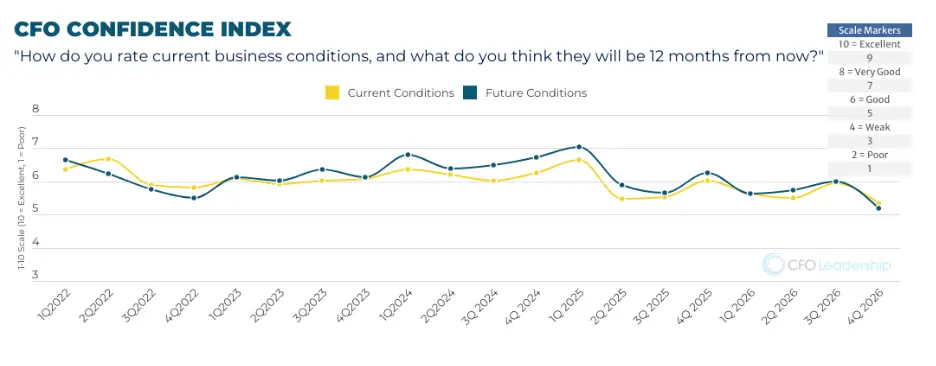
CFO confidence took a sharp hit in the fourth quarter, falling to levels not seen since the inception of CFO Leadership’s CFO Confidence Index amid the global pandemic in 2020.
And unlike their CEO counterparts, who found some reassurance in the results of the midterm elections, finance chiefs see little improvement ahead.
Our fourth-quarter poll, conducted November 4–6 among 246 U.S. senior finance executives, finds CFOs rating current business conditions 5.4 out of 10, down 10 percent from the third quarter (6.0). It is the steepest decline since the tariff turmoil of spring 2025, when confidence plunged 18 percent but bottomed out at 5.5.
CFOs’ outlook for the next 12 months is even weaker, at 5.20, down from 6.0 in Q3 and the lowest year-ahead forecast recorded by the Index.
The deterioration leaves CFOs well short of where they expected to be. A year ago, they forecasted business conditions would reach 6.3 by Q4 of 2026. Instead, current conditions are running about 15 percent below those expectations.
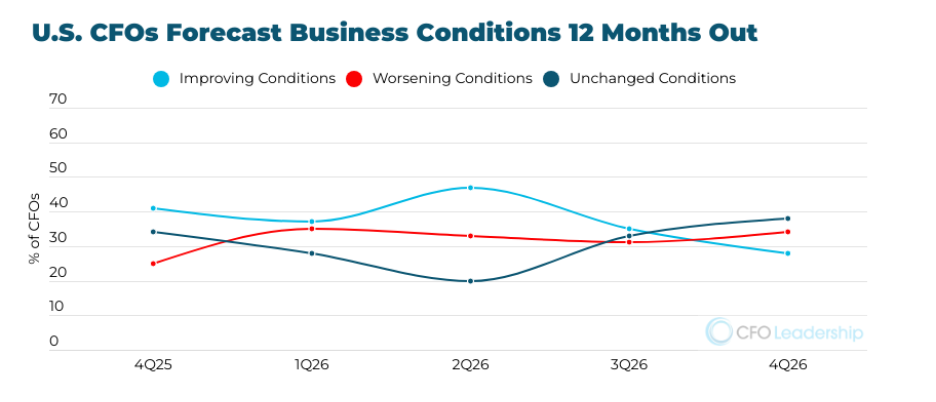
Making matters worse, just 28 percent anticipate improvement over the coming year, down from 35 percent in Q3. Another 38 percent expect conditions to remain unchanged, while 34 percent foresee further deterioration.
In explaining their outlook, CFOs point to a combination of weakening demand, persistent inflation and cost pressures, and uncertainty about the direction of the economy. Political and regulatory instability also weighs heavily on sentiment, alongside concerns about interest rates, access to capital and geopolitical tensions.
For many, it is not one particular threat but the accumulation of challenges—and the difficulty of predicting what comes next—that is clouding their outlook.
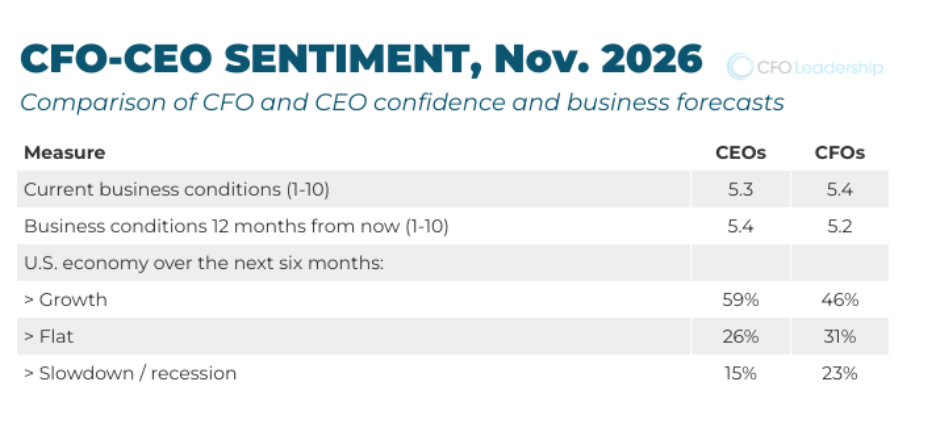
The findings mirror the weakening sentiment among CEOs: Chief Executive’s November CEO Confidence Index, conducted November 3–5 among 435 U.S. CEOs, found top chiefs rating current business conditions 5.3 out of 10, virtually identical to CFOs. CEOs’ year-ahead forecast however stood at 5.4, compared with 5.2 among CFOs.
One important distinction is that CEOs expressed greater confidence in the broader economy: 59 percent anticipate U.S. economic growth over the next six months, compared with 46 percent of CFOs.
The Midterm Impact
CEO sentiment seemed to positively respond to the midterm election results, with those responding after results started being announced during the evening of November 3 reporting more optimism for the year ahead.
CFO sentiment provided no comparable election-night rebound since the poll opened post-results on November 4. However, CFOs’ comments suggest that the election results produced a far-from-uniform effect. Some, like CEOs, welcomed the prospect of greater stability, while others feared new obstacles to growth.
“The election is over and I think there will be resolution to the drivers of instability in market,” said one pharma CFO.
Others cited concerns about congressional gridlock, taxes and the direction of economic policy.
“Political inability to address increasingly urgent issues,” wrote one finance executive.
Financial Services CFOs See Trouble Ahead
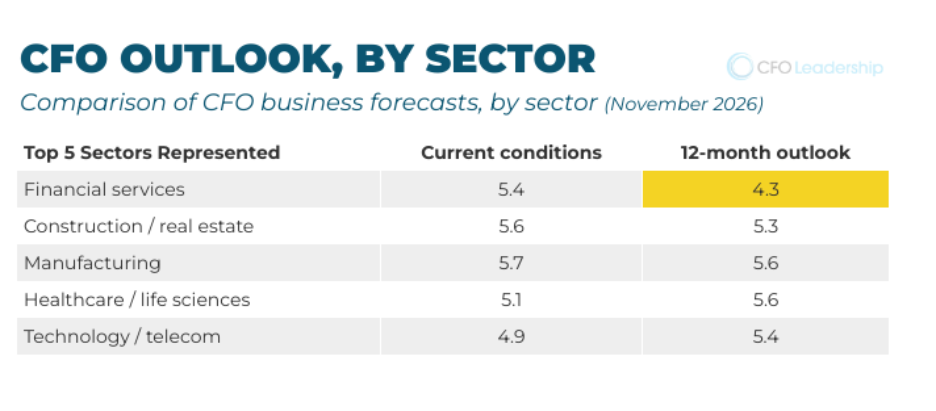
The divide in outlook is especially pronounced in certain industries, where CFOs’ assessments of the coming year differ dramatically.
Among financial services respondents, the average forecast for business conditions 12 months from now is just 4.3 out of 10, down from their current rating of 5.4. That puts their outlook 17 percent below the overall CFO average of 5.2, making financial services one of the most pessimistic sectors in the survey.
Seven in 10 expect conditions to deteriorate—the largest share among the major sectors represented in the survey. Only 11 percent anticipate improvement.
Their concerns span several fronts: “Interest rates, inflation, consumer confidence, taxes, threats to corporate profitability and resulting investment,” wrote one financial-services respondent, who expects conditions to fall from 3 to 2 by this time next year.
Another cited “Inflation, rising rates, consumer spending, repayment issues.”
The pressures are not confined to the domestic economy. One finance executive pointed to rising Australian interest rates and changes in real estate taxation as factors that could slow economic activity and potentially trigger a recession.
For others, the challenges are more immediate. One respondent cited “Difficulty of raising capital,” while another pointed to market consolidation making competition more difficult.
The contrast with other sectors is striking, particularly when looking at manufacturing.
Manufacturing CFOs, who accounted for 18 percent of the respondents, the largest group represented in the survey, rated current conditions 5.7 and expect them to remain relatively stable at 5.6 over the next 12 months. Only 30 percent forecast deterioration, compared with 70 percent in financial services.
While some manufacturers continue to struggle with tariffs, rising material costs and weaker demand, others report strong order books and expanding markets.
“Our current backlog of work is one year deep, and we are still receiving numerous projects to quote,” said one manufacturing CFO.
Others cited aerospace, defense spending, semiconductor demand and data center construction as sources of continued growth.
Smaller Companies Face a Tough Climb
Company size reveals another important dividing line.
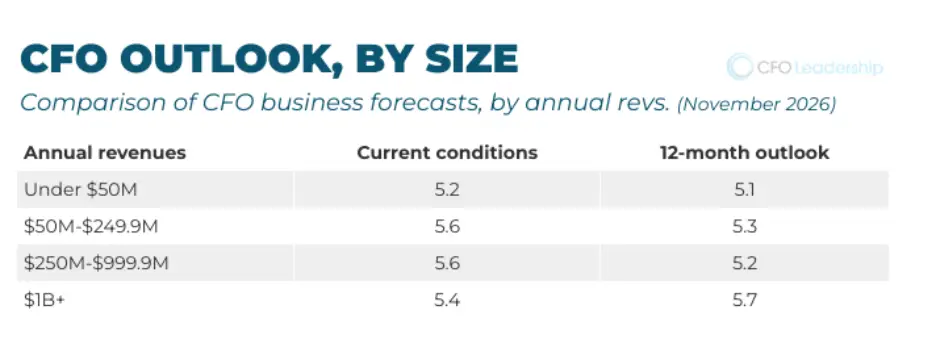
CFOs at businesses with less than $50 million in annual revenues rated current conditions 5.2, below the overall average. Their forecast for the year ahead stands at just 5.1.
By comparison, CFOs at companies with $1 billion or more in annual revenues expect conditions to improve from 5.4 today to 5.7 next year.
The divide is even more apparent in their economic forecasts: Only 36 percent of respondents at companies below $50 million anticipate U.S. economic growth over the next six months, compared with 71 percent at companies with revenues of $1 billion or more.
The comments suggest smaller businesses are contending with a combination of higher input costs, financing pressures and uncertain customer demand.
“Tariffs, unstable inputs pricing, companies tightening their purchases in response,” wrote one finance executive at a manufacturer with less than $10 million in annual revenues.
Another, at a financial-services company of similar size, cited “Inflation, AI effect on jobs and consumer debt.”
Some smaller businesses are seeing the impact directly in customer behavior. One respondent observed: “I’m in the wine industry and fewer people are spending money on wine.”
Or, as one CFO at a small energy company put it: “We’re screwed.” He expects conditions to fall from 8 out of 10 today to 4 by next fall.
Those pressures appear to be tempering expectations for their own companies, too.
Just 67 percent of CFOs at businesses below $50 million forecast higher revenues in 2027, compared with 95 percent at companies with revenues of $1 billion or more. Only 56 percent of the smallest-company group expect higher profits, compared with 76 percent of the largest.
The contrast underscores a challenge for smaller businesses: They often have fewer resources to absorb rising costs, finance expansion or withstand prolonged uncertainty, even as larger companies continue investing for growth.
Private Equity-Backed Companies Offer a Brighter View
Not every segment is contributing to the gloom. CFOs at private equity-backed companies are among the more optimistic respondents, with an average year-ahead confidence rating of 5.5, slightly above their assessment of current conditions.
Among the respondents in this group, 42 percent expect business conditions to improve over the next 12 months, compared with 23 percent anticipating deterioration.
Their expectations for their own companies are stronger still: 88 percent forecast higher revenues in 2027, and 85 percent anticipate higher profits.
Nearly six in 10 expect to increase headcount, compared with 44 percent of CFOs overall.
The comments offer glimpses of how some of these businesses expect to grow, even in a challenging environment.
“Organic growth through share capture,” wrote one private equity-backed manufacturing executive.
Another pointed to “organic growth, ops efficiencies through equipment and process modification, cost stabilization.”
Still, only 31 percent anticipate U.S. economic growth over the next six months, despite their comparatively positive outlook for their own businesses.
CFOs Still Expect to Grow
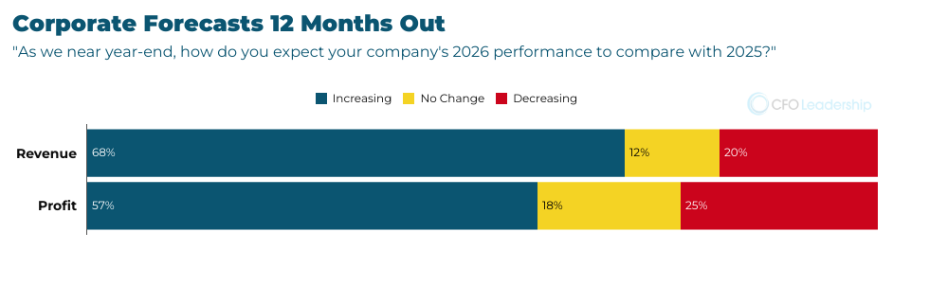
Nearly seven in 10 CFOs polled expect to close 2026 with higher revenues than in 2025, and 57 percent expect higher profits.
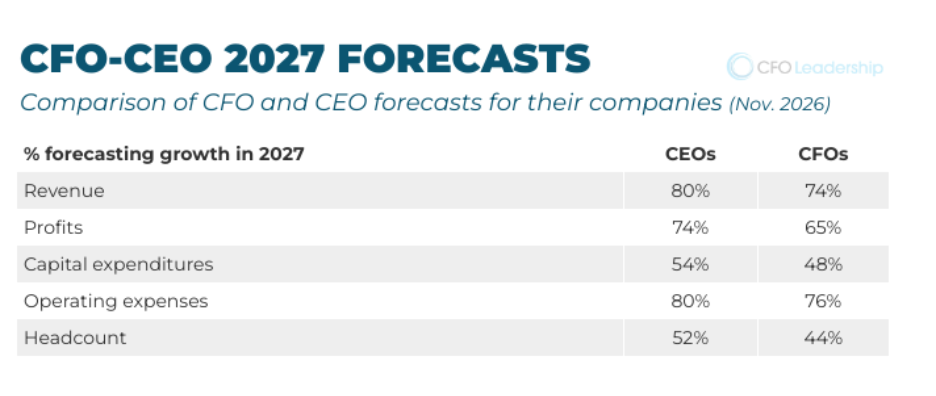
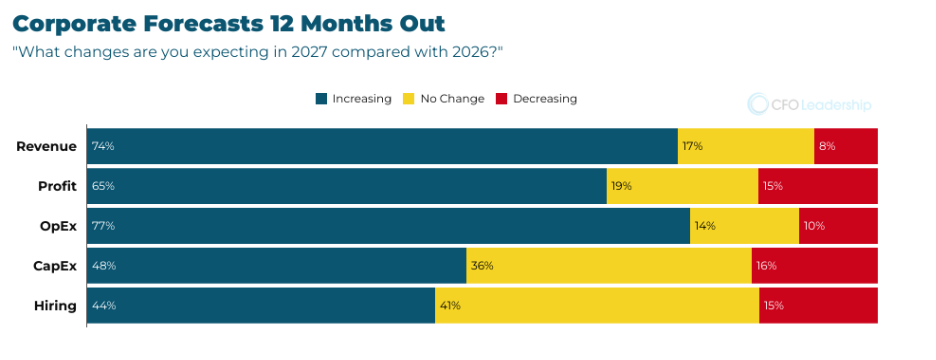
Looking ahead to 2027, those expectations strengthen. Nearly three-quarters—74 percent—forecast higher revenues, up from 67 percent in Q3. Another 65 percent anticipate higher profits, compared with 64 percent last quarter.
Capital spending plans have also been strengthening throughout the year. The share expecting to increase capital expenditures in 2027 now stands at 48 percent, up from 38 percent in January.
Hiring expectations remain more restrained, with 44 percent planning to expand headcount.
The outlook is notably less bullish than that of CEOs, among whom 80 percent expect higher revenues and 74 percent higher profits in 2027. CEOs are also more likely to anticipate increased capital expenditures and hiring.
Still, even among finance chiefs forecasting deteriorating business conditions over the next 12 months, 68 percent anticipate higher company revenues in 2027 and 61 percent expect higher profits.
As one manufacturing CFO explained, “the general business conditions with the current economic climate are a concern,” he wrote, “[but] we have some good opportunities going that should help growth.”