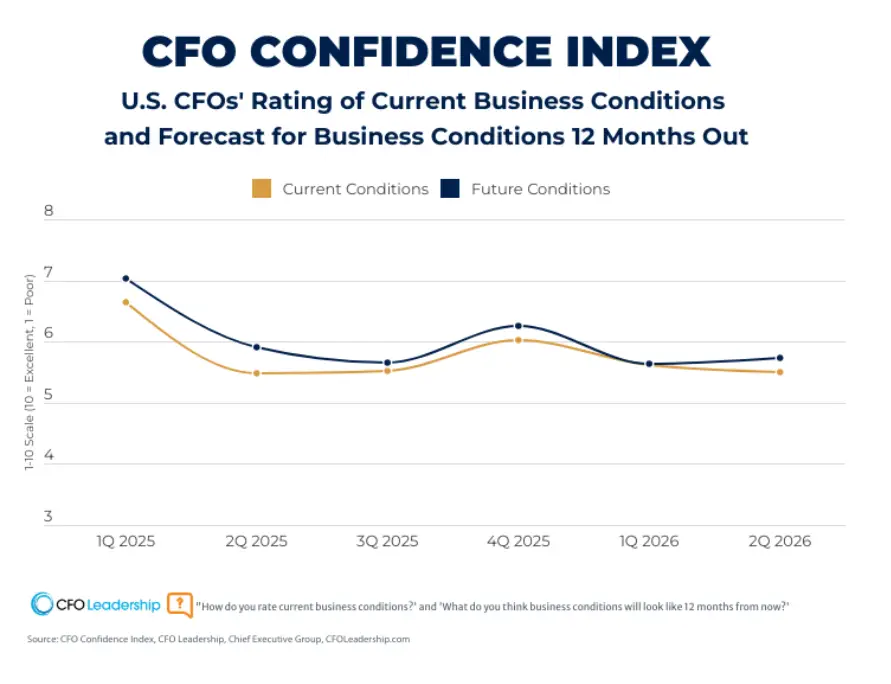
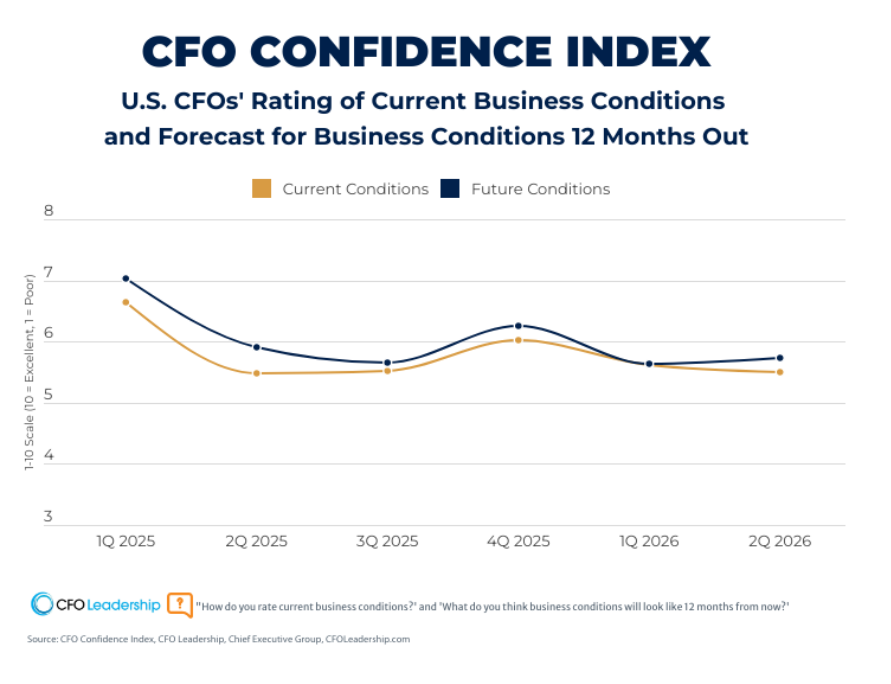
CFO confidence is stabilizing in Q2—and tilting cautiously upward—after a volatile start to the year that saw our CFO Confidence Index fall by double digits in Q1.
CFO Leadership’s Q2 CFO Confidence Index, based on a survey of 126 finance chiefs conducted April 22-26, shows sentiment toward current business conditions essentially flat quarter over quarter (-2 percent), while expectations for the year edged higher by a similar margin (+2 percent).
CFOs rate current business conditions a 5.5 out of 10 (on a scale where 1 is Poor and 10 is Excellent) and expect conditions to improve modestly over the next 12 months, to 5.7. While not a significant shift from last quarter, the data suggests optimism is beginning to rebuild—albeit cautiously.
Nearly half (47 percent) of CFOs now expect business conditions to improve over the next 12 months, up from 37 percent in Q1 and back in line with year-ago levels. Among those executives, the expected upside is substantial: a 33 percent increase, from an average rating of 5.0 today to 6.5 a year from now.
That outlook, however, is more often tied to internal growth initiatives rather than broad market improvement. Dan McAllister, CFO of Avantiico, says the combination of rising costs and flat services rates is driving a push toward AI-enabled offerings: “We are retooling the team to create and provide more AI-oriented professional services.”
Others point to similar efforts. Caitlin O’Brien, director of financial operations at Corderman & Company, cites the company’s ability to scale revenue: “The next phase of value creation will depend on improving operational consistency, strengthening cost controls and institutionalizing best practices across the organization.”
Some CFOs, meanwhile, expect relief from macro pressures. “Once war is behind us and [we have] a new Fed chair, expect a ‘peace dividend,’ inflation to cool [and] lower interest rates all spurring confidence for consumers and businesses,” says Michael Pechette, CFO of the large-sized industrial manufacturing firm GB Manufacturing.
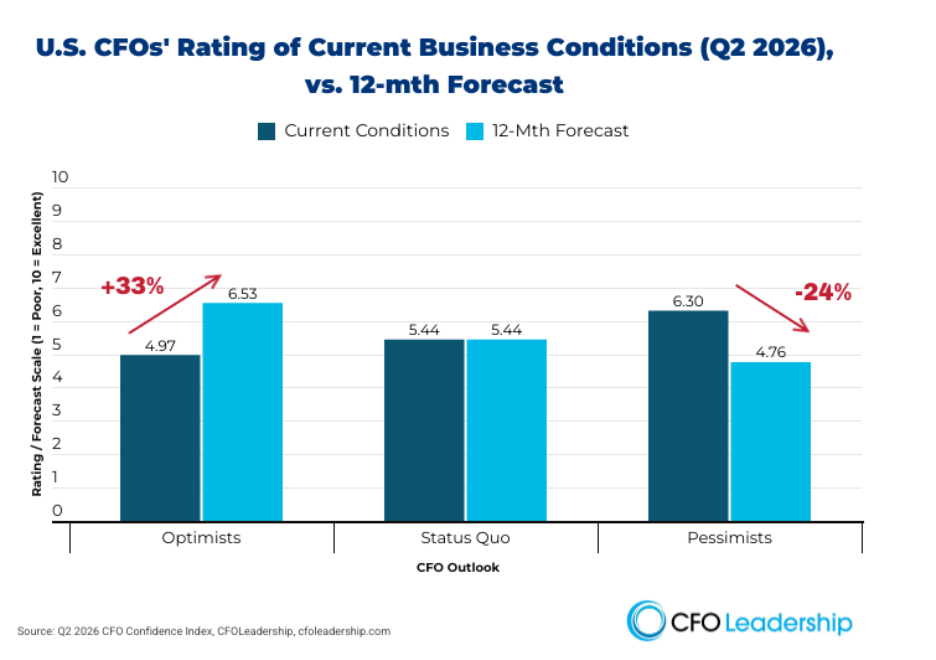
At the same time, fewer executives expect conditions to remain unchanged, declining from 28 percent in Q1 to 20 percent in Q2. While much of that shift moved toward optimism, the share of CFOs forecasting deterioration held relatively steady (33 percent vs. 35 percent in Q1). But among those leaders, the expected decline is also significant: a 24 percent drop, from 6.3 today to 4.8 over the next 12 months.
These CFOs were more likely to point to external pressures shaping their outlook. Mark J. Cvrkel, CFO of Kish Bank, cited “continued volatility in the markets, higher energy costs and slowing employment growth,” alongside persistent inflation. Others echoed similar concerns, including the “Iran war and AI disruption in the economy leading to lower disposable earnings.”
CEO-CFO Alignment
CFO sentiment in Q2 closely mirrors that of CEOs, though with a slightly more restrained tone.
Chief Executive’s April CEO Confidence Index also showed stabilization in sentiment, with confidence in current conditions rising 2 percent to 5.5 and expectations for the year ahead improving as well. Like CFOs, CEOs appear to be finding equilibrium after a volatile start to the year.
Both groups are becoming modestly more optimistic, driven in part by a shift away from neutral expectations. Among CEOs, 52 percent now expect conditions to improve, up from 48 percent, while fewer anticipate no change. CFO responses show a similar pattern.
At the same time, sentiment remains split. Even as more executives expect improvement, a consistent share anticipates deterioration, reflecting a more polarized outlook.
That tension is reflected in the issues cited by both groups. CEOs pointed to tariffs, war and energy, while CFOs highlight volatility, rising costs and slowing employment growth.
Corporate Forecasts
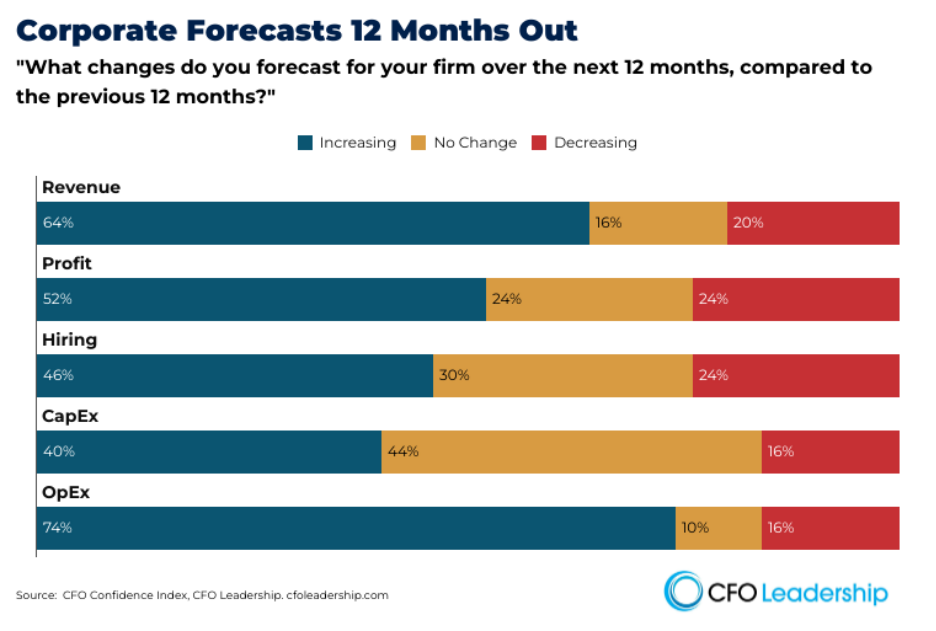
This polarization is reflected in CFOs’ expectations for their respective organizations:
- 64 percent forecast revenue growth this year (down from 73 percent in Q1)
- 52 percent expect profit growth (down from 56 percent)
- 40 percent plan to increase capex (up from 38 percent)
- 46 percent plan to add headcount (up from 44 percent)
- 74 percent expect operational expenditures to rise (unchanged since Q1)
About the CFO Confidence Index
Every quarter, CFO Leadership surveys hundreds of CFOs across America at organizations of all types and sizes to inform our CFO Confidence Index, a real-time and forward-looking tracker of CFO confidence in current and future business environments, as well as their forecast for their company’s revenue, profit, capex and cash/debt ratio for the year ahead. Learn more at CFOLeadership.com/cfo-confidence-index/