Editor’s Note: Glenn Hopper, a regular contributor to the FATE eNewsletter, is one of the country’s top experts on the intersection of finance and technology (check out Glenn’s Deep Finance Dispatch). He’ll host our upcoming AI in Finance Forum on November 12, the eve of the Finance & Accounting Technology Expo in New York. Join Us >
If you lead finance, you have whiplash. Your inbox is full of magical AI demos. Your team is drowning in AI “quick wins.” Your audit partner just asked how you govern prompts. Somewhere between the keynote and your quarter close, enthusiasm turned into vertigo.
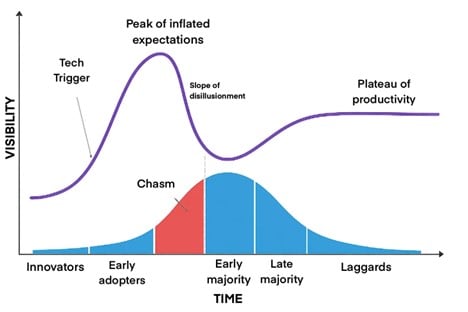
We have officially slid off the Peak of Inflated Expectations and into the Trough of Disillusionment; not because the technology failed, but because expectations did. The headlines tell the story:
- MIT (2025) reported that 95 percent of generative AI pilots fail to reach production, citing poor data readiness, lack of governance and unclear ROI as primary barriers (MIT Sloan Management Review, 2025).
- Deloitte’s AI blunder (2025) made global news when the firm refunded a client after an AI-generated report included fabricated legal citations and imaginary research papers (Financial Times, October 2025).
- Air Canada’s chatbot case (2024), where an airline’s customer service bot invented refund policies that did not exist, became an instant parable for uncontrolled AI automation and corporate accountability (CBC News, February 2024).
Each failure reinforced the same lesson: The issue is not that AI cannot deliver value, but that organizations do not yet know how to manage it. CFOs now face the fallout from questions about trust, governance and whether it is safer to sit this wave out.
Where We Are in the Cycle
Gartner’s Hype Cycle and the Technology Adoption Curve together explain the tension finance leaders feel today. The Hype Cycle shows how enthusiasm for new technology rises to a peak of unrealistic expectations before falling into disillusionment and finally leveling off as real value emerges.
The Adoption Curve adds the human element: Innovators and early adopters rush forward, while the early majority waits for proof, structure and predictable outcomes. When the decline of hype meets the hesitation of the early majority, leaders feel the ground shift beneath them, which is precisely where most CFOs now stand.
This confusion has a human side too. The emotional toll of repeated processes and the pressure to deliver accuracy make it easy to lose sight of how transformation should feel inside the finance function. The conversation about technology often ignores the people who live inside these systems. Before finance leaders can transform workflows, they must confront the emotional weight of the work itself.
The Sisyphus Moment for Finance
The metaphor captures the grind of traditional finance work, but it also mirrors the early stages of AI adoption. Teams push tirelessly, repeating the same motions, often unaware that automation could take the weight. This connection shows how technology offers not just relief from routine but the chance to redefine what progress looks like.
Month-end close. Account reconciliations. Reports that repeat every quarter. It is Sisyphus. The same weight, the same motion.
Camus told us to imagine Sisyphus happy because meaning lives in the struggle.
Generative AI creates a different question: What if the rock actually clears the summit?
Picture the moment when the impossible happens: The rock, pushed day after day, finally crests the hill and begins to roll on its own. The strain eases, momentum takes over and the world shifts beneath your feet. In that instant of release there is both relief and uncertainty, a pause before you realize that everything you once resisted is now pulling you forward.
The real risk is failing to notice when gravity has shifted. In that moment, leadership becomes about awareness rather than force…about recognizing that the challenge has changed shape. Many teams keep bracing out of habit, even as the stone tips over the ridge. They do not see that what once required struggle now needs guidance to keep momentum steady.
Why the Fear Feels Real
It is not just about model accuracy. The anxiety comes from an operating-model gap, not a technology gap.
- Use-case economics are vague. Benchmarks do not help your close. You need unit economics per reconciliation, per variance explanation, per policy review.
- Control and accountability are fuzzy. Who signs off when a model drafts a disclosure or posts an accrual? Ownership is unclear.
- Workflow fit is poor. Off-the-shelf tools bolt onto legacy steps instead of redesigning the process for machine and human together.
- Measurement is shallow. Teams count clicks and latency. Finance needs cycle time, exception rate and quality at cost.
- Change fatigue is real. People know how to push the boulder. Letting go creates vertigo. Often we fear success because it demands a new way of working.
- Data readiness lags. Document sprawl, policy drift and messy master data kill ROI faster than hallucinations.
Why This Future Matters
This vision of finance matters because it shows what happens when human potential and technology align. AI removes the friction that has long defined financial work. The shift is not about replacing accountants or analysts but about returning focus to strategy, insight and forward thinking. It turns the act of closing the books into an act of seeing what is possible next.
It redefines the purpose of finance leadership. When the mechanics of reporting run on their own, CFOs gain space to interpret patterns, model new futures and lead transformation instead of managing throughput. It is the difference between keeping the engine running and steering the ship toward new horizons.
What the Other Side Looks Like
Imagine stepping onto a different landscape of finance where the daily grind has been replaced by continuous flow and foresight. The boulder that once demanded constant effort now rolls forward with its own momentum, and your role shifts from pushing to steering. This is not just a vision of efficiency but of purpose. It represents a fundamental change in why finance exists: to create clarity from complexity and to shape outcomes before they unfold.
This transformation is about motivation as much as mechanics. It gives finance professionals a renewed sense of agency and creativity. The hours once lost to reconciliation and reporting become time for exploration, insight and influence. When work becomes continuous and intelligent, finance evolves from a reactive function into the operating system of decision-making.
- Continuous close. Reconciliations and subledger checks happen in real time, each transaction validated as it occurs. Reports update themselves, and the books are never truly closed because they are always current.
- Live variance narratives. Explanations surface automatically from streaming data and evolving policy, ready for an analyst to refine rather than rewrite.
- Ambient compliance. Controls hum quietly in the background, built into every process. Evidence appears where it is needed, turning audit prep into a confirmation exercise instead of a scramble.
- Forward posture. Finance teams stand at the edge of what comes next, designing scenarios and guiding strategic decisions rather than explaining what went wrong last quarter.
You Need a Sherpa, Not Another Demo
A guide does not sell a model. A guide owns the ascent. This is leadership that combines method, empathy and discipline. The right Sherpa brings context, structure and endurance to a climb that others only talk about from the base.
To reach the top, CFOs need more than proof-of-concept slides. They need someone who can translate ambition into architecture and excitement into measurable outcomes.
- Process first, tool second. Start with your ledger-to-report map. Identify decision points, controls and evidence. Select technology after the design.
- Governance by design. Define who approves what, which artifacts are stored, escalation rules and rollback steps before a single prompt goes live.
- Human in the loop where it matters. Specify when a person must review, when thresholds trigger intervention and how feedback retrains the system.
- Value instrumentation. Tie every use case to time saved, error reduced, cash improved and risk lowered, then show that score weekly.
- Vendor-agnostic assembly. Treat LLMs, RPA and workflow as interchangeable parts behind finance-owned standards.
Having a Sherpa means you do not have to navigate alone. It is the difference between watching others attempt the climb and knowing your own route to the summit. The consultant who succeeds here does not bring more hype but focus, stamina and proof of traction at every step.
Monday Actions for the CFO
Start the climb now by assessing your first process and finding the guide who can help you take that initial step toward transformation.
- Name a guide. Appoint a Finance AI Sherpa who owns one 90-day ascent.
- Pick one boulder. Choose a single process with heavy repetition and manageable risk. Publish the baseline by documenting and sharing your current process performance before automation begins. Track key metrics like cycle times, exceptions and error rates to measure progress and align the team around a clear starting point.
- Set your destination. Define what success looks like in clear, measurable terms and decide in advance how you will know when the work is done. These “rock-cleared” indicators might include faster closes, fewer exceptions or improved confidence in your data. When they appear, allow yourself and your team to ease the pressure, acknowledge the progress and prepare for the next climb.
CFOs have every reason to be cautious. The noise around AI has been deafening, and the stakes are high. But fear and hesitation are signals, not stop signs. They are like standing on a narrow ridge and feeling the height of what comes next. They remind you to move deliberately, to keep your footing and to trust the guide who knows the terrain. They point to what matters most: getting the guidance, structure and trust right before scaling the next face of the mountain.
You do not need to conquer the mountain overnight. You need the right map and the right companion for the climb. Meet the technology where it is and bring your team along as it matures. Each deliberate step builds the muscle memory your organization will rely on for the next decade.
There is a better world on the other side. Finance will not lose its rigor or control. It will gain time, context and creative capacity. What once felt like an endless climb can become forward motion. The myth gave Sisyphus no choice. You have one. The question is not whether the stone can cross. It is whether you will recognize when it already has.