
The finance function is undergoing a fundamental transformation, and it’s happening from within the ERP itself. Modern cloud-based financial management systems like Sage Intacct—a leading ERP platform designed specifically for finance teams—are now embedding artificial intelligence directly into core accounting workflows.
The capabilities already operational include anomaly detection in the general ledger, OCR invoice capture in accounts payable, intelligent cash application in accounts receivable, and natural language querying of financial data. By 2026, Sage plans to roll out even more ambitious features: autonomous workflow orchestration that can draft journal entries for review, and what Brenda Kahier of financial technology consultancy Armanino calls “the full autonomous close and finance operation.”
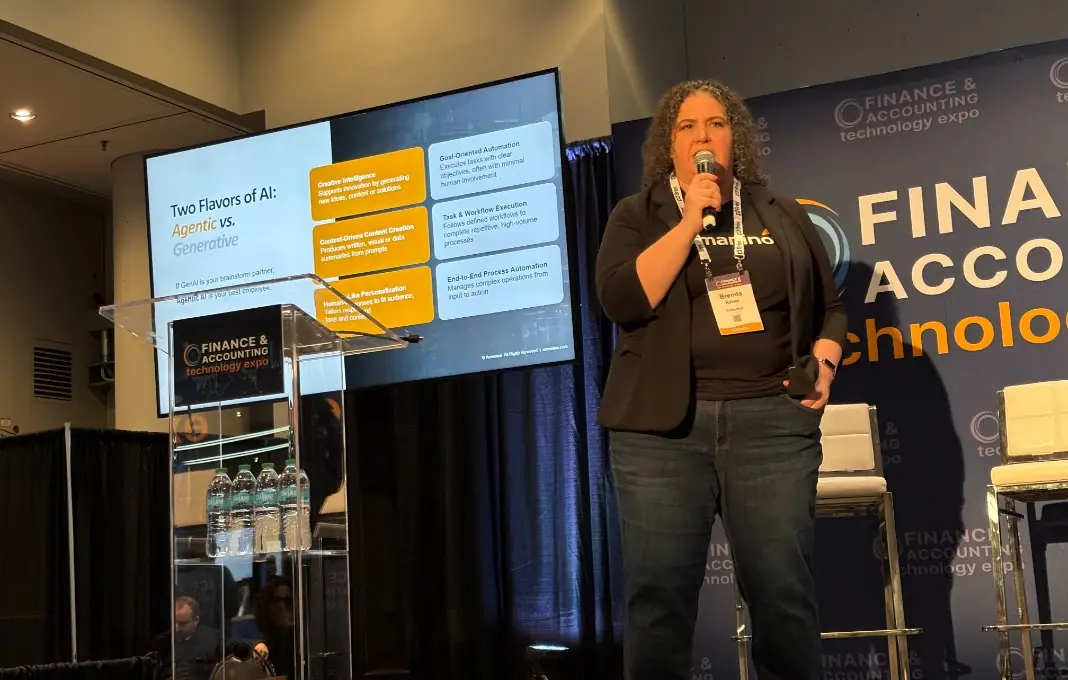
But here’s the challenge: While the technology is ready, most organizations aren’t. At CFO Leadership’s recent Financial Accounting and Technology Expo in New York, Kahier and her colleague Carmel Wynkoop walked finance leaders through the practical realities of adopting AI-driven ERPs. Their sobering statistic, cribbed from a recent MIT study: “95 percent of organizations proof of concepts with AI fail,” according to Wynkoop. The reason? “They failed because they have not identified the right use cases.”
For CFOs navigating this transition, success depends less on the technology itself and more on how you approach adoption. Here’s what they say actually works:
Fix your processes before you automate them. The greatest risk in adopting AI-driven ERPs isn’t the technology—it’s automating dysfunction. “Don’t make a bad process go faster,” Wynkoop cautioned. “Make sure that your process, you’ve identified it, that you’ve got something that is a strong, solid process.” AI will amplify whatever you feed it, whether that’s an efficient workflow or a chaotic one. Before turning on AI features in your ERP, CFOs need to ensure the underlying processes are sound.
Keep humans in the loop, always. One of the most dangerous assumptions CFOs can make is that AI’s sophistication means it can operate without oversight. “You wanna be Iron Man, not the Hulk,” Kahier said. In the Iron Man model, humans remain engaged with the AI, communicating and collaborating. The Hulk model? “He has no memory of what just happened, and it just happened and neither him nor the human knows how it happened.”
The risk extends beyond immediate errors. Kahier warned that over time, “if we take it to its logical end conclusion…at some point, nobody’s going to understand how that bot works because they never did the work, they didn’t build it.” For CFOs, this means building verification protocols today—even when AI delivers the right answer—to maintain institutional knowledge and accountability.
Start small and measure relentlessly. CFOs must resist the temptation to tackle their biggest problems first. “You want the ones that give you immediate time to value…so that you’re making small incremental changes at the beginning, but you’re getting the benefit out of this with the ROI,” Wynkoop advised.
Identify use cases that will generate quick wins and enthusiasm among your team. Document the time savings, the error reduction, the productivity gains. Then use those metrics to build the business case for broader adoption. Without measurement, you can’t demonstrate success—and without demonstrated success, you won’t secure resources for the next phase.
Recognize that data quality is the foundation. “You can’t go from zero to AI,” Kahier said. “If your data is not in good shape, if you don’t have alignment across the organization about what that success is…that’s going to really come out.”
Before implementing AI-driven ERP features, CFOs need to audit their data quality. Is historical information accurate and consistent? Are naming conventions standardized? Do different departments define key metrics the same way? The AI will only be as good as the data you train it on—and poor data quality will surface immediately.
AI integration into ERPs like Sage Intacct offer transformative capabilities for finance functions, from continuous close processes to real-time predictive analytics. But the technology is only half the equation. Success requires discipline: clean data, sound processes, human oversight and measured adoption. For CFOs who do that groundwork, the payoff is substantial—faster closes, better forecasting and finance teams freed to focus on strategy rather than transaction processing.