Samir Kanuga may officially serve as CFO of HelmsBriscoe, a global leader in hotel site selection and meetings procurement, but finance is only part of the story. A longtime pilot and flight instructor, Kanuga approaches leadership through the lens of aviation—balancing growth with risk management, precision with adaptability and strategy with trust.
In this episode of Secrets of Rockstar CFOs, he joins Jack McCullough to discuss lessons learned from manufacturing and family-owned businesses, leading through uncertainty during the pandemic, the importance of “walking the floor” and why transparency remains one of the most important traits for finance leaders today. Listen by clicking below. The Q&A, lightly trimmed and edited for clarity, follows.
—
Listen to the podcast here
This is going to be a good episode for a lot of reasons. Not the least of which is that I’m friendly with the guests. It’s great to have a friend on the show. I’ve been looking forward to it a little bit. Samir Kanuga is the CFO of HelmsBriscoe. HelmsBriscoe is the global leader in hotel site selection and placement of meetings and events. He’s the CFO there, but what’s going to unfold is he’s a lot more than a CFO. Amongst other things, he’s a pilot and an author. I’m very excited to have him. Samir, welcome to the show.
Thank you so much, Jack. It’s good to be here with you.
I have to say you have the single best background of anybody that I’ve interviewed so far. Can you take them home and describe what people are missing?
Jack, thank you again for having me. It’s a pleasure and an honor to be here with you. It’s a Zoom background that I carry around everywhere. It’s my Zoom background and my iPhone background. It says, “Live playfully. Seek adventures. Be inspiring.” That’s my personal philosophy. That’s how I live my life and I remind myself of that all the time.
Live playfully is because I like to joke around, tease and have fun in life. Seek adventures comes from my love of flying. I love to fly. I’m a flight instructor. I love to travel and see new areas. I have that curious mindset. Be inspiring comes from a tribute to all the mentors that have helped me get to where I am now in my finance career as well as in aviation. I’ve had a lot of people that have helped me. I have been flying since I was 12 years old. A lot of people have helped me along the way and I like to do the same. I always help out the next generation of finance leaders as well as people that are interested in aviation and help them take their introductory flight and show them aviation.
That’s a high note. We should in the episode right here. That’s a fantastic philosophy and we’ll come back to that. I wanted to also give you an opportunity. I know HelmsBriscoe pretty well because I’m a client and they do some great work. Maybe you can fill in the blanks a little bit about what the business model is.
Thank you, Jack. I’ve got three full-time jobs. My first is I’m the CFO of HelmsBriscoe, which is the largest company for meeting site selection. We help companies and organizations find meeting space and hotel rooms all over the world. My wife and I have three kids. We’ve got twin girls and a boy.
I joke around that it’s my other full-time job. That’s a full-time job, especially for my wife. She’s at home, taking care of these kids. They are a lot of energy. Thirdly, as I mentioned, I’m a flight instructor. That’s my passion. I love flying and teaching about flying. I’ve even been encouraging safety in the aviation community.
You’re a busy guy. I’m always grateful when people come on the show, but especially grateful in your case. I do thank you for making the time. I want to explain your career because it’s been quite interesting but let’s talk a little bit about the earlier years. Where did you grow up?
My brother and I were born and raised in Los Angeles, California. When I was about 12, we moved to Columbus, Ohio, which was a complete shock to the system. We had never seen snow right outside of our house before. It was a great experience. At that time, it was a lot of shock moving from LA to Columbus, Ohio, the suburb of Columbus.
My dad said, “Embrace this change. It will be an experience you’ll never get again.” I have to say that’s completely true. I’m proud of where I grew up. In the Midwest, I learned about Midwestern hospitality and Midwestern work ethics. It gets to see the heart of the country and I loved it. After college, I went to the Ohio State University. I came back out west to LA and live in Phoenix now.
In Ohio State graduates, you always emphasize the part of the university.
It’s the best marketing.
I became familiar with that from Monday Night Football. They were the first that the players would say where they came from. I notice the Ohio State players will always say, the Ohio State University. I’m just showing off or something, but that’s the actual name, right?
That’s right. We’re very proud of our school. Go Bucks.
Other than military schools like the Citadel and then Archie schools like the Berkeley College of Music. There’s not a lot of schools with the at the beginning of the name. That will be another episode. We will explore why the Ohio State University is in fact the Ohio State University. I’m sure it will be exhilarating for the readers. What did you study at Ohio State?
I did my undergrad in finance and masters in finance at Arizona State University. I love big colleges, two of the biggest colleges in the United States.
That makes a whole lot of sense. From an early career, you may or may not have been thinking about being a CFO, but that’s in your family, finance and accounting.
That’s right. I’m lucky. My dad has been in accounting for 50 years. He’s been a CFO for the past 40 years. My mom has been in accounting for 40 years and my wife has been an accountant for over 10 years. I was destined to be a CFO.
I’m going to go out on a limb and try to surmise what your kids might grow up to be.
I have a younger brother who works on medical devices.
He’s the outcast of the family. You’ve got all of that and nobody’s destined to be a CFO, but clearly your parents had a strong influence on a lot of things, as they should right. Your dad is still a CFO. You seem to phrase that in the present tense.
That’s right. We’re very close. He’s still active doing everything he can and I learned a lot from my parents. They immigrated to the United States when they were 20 years old with five dollars in their pocket, and my wife, too. She came to the United States to study at the University of Scranton when she was 20 years old and English wasn’t her first language. She learned it when she was almost 18 or 20 years old. Now, she’s fluent.
I’m proud of what they’ve done and built here in the country. I’ve learned so much. As you can imagine, having everyone in accounting in the household, what our dinner tables were like, Thanksgiving dinners and Christmas dinners. It’s talking about cashflow, management, optimizing KPIs and working with the banks. I’ve learned so much from my parents because of that.
It’s amazing the influence they have, particularly on you. Do you ever go to your mom or dad for career advice still at this point?
All the time.
He’s seen it, right?
My dad is my best friend and we speak all the time.
Tell me, what was your first job?
My first job was a paperboy when I was 12 years old.
That’s weird, because I don’t count that sometimes when we talk about my first job. My first job was also as a paperboy and for the benefit of the audience under 40. Should we explain what the concept of a paper boy is?
Sadly, I still get a newspaper every day.
I delivered the Boston Globe and the Boston Herald seven days a week. I had to get up an hour before all of my friends were. I made like eight dollars a week. It taught me some responsibility and practices at a relatively young age.
It’s so much fun. With eight dollars, you probably thought you were a millionaire.
I remember at the end of the year, the tipping would increase. One of my neighbors gave me a dollar tip, I was through the roof. We’re in Burlington, but there’s like a dollar for like an entire year’s worth of visiting their house.
It’s so much fun. I learned one of my early life lessons being a paper boy, and I learned it from my mom. The first day, I was delivering an afternoon newspaper. It was a weekly city newspaper and I came home from school. It’s my first day of being a paper boy. You know how the newspaper companies leave it to you. They leave it on the porch. The whole stack of newspapers and then the bags next to it, where you need to fold it and stuff it and then deliver it.
I see this huge stack of newspapers. There’s probably 400 houses on the route, and I had a bit of an anxiety attack. I said, “Mom, there’s no way I’m going to be able to deliver 400 newspapers. We need to fold it, stuff it and deliver it. This is impossible. I can’t do this no way.” My mom taught me the most important lesson at that time. She said, “Start. Sit down and just start.” That’s what we did. She helped me out. She ended up being a great partner. She is so good at taking massive projects or something that looks daunting and just starting without overthinking it.
There’s a lesson to be learned there. You can’t eat the elephant all in one bite. Take it small bites and small bites and it will all work out. It was a great experience. We ended up growing that route to over 1,000 homes and did very well with it. It was an embarrassing story, looking back at how daunting that task was.
It wasn’t unrealistic either, delivering 400 newspapers. It’s not like you had a driver’s license at 12 years old.
Exactly.
You’re riding a bike or walking.
Rollerblades.
I’m not sure the rollerblades were invented when I was 12. There’s roller skates but they’re not the most efficient thing. Anyway, it’s amazing how a paper route made such an impact on you. Tell us a little bit about what was your first job when you graduated? What was that like?
After college, I worked for Wells Fargo in retail banking.
What did you learn from that, that maybe helped prepare you for a future role as a CFO?
There’s so much I learned there. It was an unbelievable experience, of course, working with people as they interacted with our stores coming in and being able to provide the customer service. That could be teller services, wire transfers and whatever they needed helping with their savings plans or investment. I was licensed for securities.
After that, I know at one point you worked at Royal Paper and that was your first ever CFO role. Tell me about that experience and lessons learned. Perhaps you have some mentors that you met along the way who are helpful to your path.
What a great experience it was at Royal Paper. Royal Paper is based in Phoenix, Arizona. It’s a privately held manufacturing company of bath tissue, which is the formal word for toilet paper. We made bath tissue, paper towels, paper napkins and facial tissue and shifted all over the country. I started there in finance and operations at one of the divisions, which was the paper mill in Gila Bend, Arizona. It’s a small little town. Maybe with a population of 2,000 people, and helped to turn that around, and I learned so much.
One of the CFO lessons that I take from that time is I started by cleaning that paper machine every single day. I made it a point to walk the production floor every single day and meet with all the employees, talk to anybody and then see the raw materials coming, how they were used, and then the product going out the door and how we made revenue. As a CFO, looking back, I knew every single lever of that company, how to make more money, or how to save money on raw materials. That’s probably one of the biggest lessons as a CFO that I had. It’s how intricate the manufacturing process is, and how everything is in the details.
I was a CFO but I spoke to people that were much more successful in the role that I was. All of them said the first thing to do is walk the floor. Now, the world’s different. There are companies that don’t have physical floors to work, but it’s a metaphor now for understanding the business.
I do that every single day. I ended up being the CFO of Royal Paper for the entire organization and walked the floor every single day. Let me give you a fun fact about paper.
There are no fun facts about paper, but you’re right.
We’re passionate paper makers over here in Phoenix. Bath tissue and toilet paper is extremely lightweight, so we measured it. The weight, when you roll it out to 3,000 square feet. Imagine a pretty good-sized home in America is 3,000 square feet. Imagine you’ve got Charmin bath tissue and you roll it out to 3,000 square feet. You covered your house. That whole thing would weigh maybe about 30 pounds. It’s very lightweight.
That was your first CFO role. You got promoted into the role, then you moved on from there in an interesting decision from a timing perspective. You joined HelmsBriscoe in June of 2020, which again, keep in mind that they are in the travel in the events space, and June of 2020 was relatively early in COVID. I’m curious how the position became available and what was appealing about it. It’s a difficult time for that industry, but you saw something.
I want to go back to March 2020. I was the CFO of Royal Paper, making bath tissue. Jack, I never in my wildest dreams thought I would see toilet paper trending on Twitter. It was not a scenario that we had planned for, and that was unbelievable to go out there. We heard from vendors, clients and friends that bath tissue is running short at the grocery stores. We sent all of our sales team and exec team out the grocery stores across America and saw bare shelves. That shocked us, because our supply chain is not built for that.
Our supply chain is basically built to grow with population. We can predict demand with pinpoint accuracy and we had no choice with COVID. It shocked us. We never anticipated or saw that coming. I’m proud of the team for stepping up during that time. We worked night and day, weekends and everything to get products out to consumers, but they’re just isn’t that much excess capacity in the system.
That was a fascinating time. I remember very early in COVID. There were toilet paper shortages, I’m going to say in Seattle or something like that.
All over.
It’s like one city got hit quicker. Boston was pretty early getting hit, but Seattle, in particular, was the first one it. It’s like, “What are toilet paper shortages?” It was a nationwide thing.
I still don’t know why but it’s one of those comfort products. People just feel reassured having enough of it.
There’s a natural tendency that when things are out of control, you look for things that you can control. Some people started buying toilet paper and others were probably thinking, “If everybody’s doing it, I got to do it.” I want to move on to HelmsBriscoe and your current job. You’ve been there for a few years and the great companies I mentioned at the top.
CFO Leadership Council is a long-time partner of yours, and a very happy one. I’d love to talk a little bit about your role there. It’s a family-owned business, as I understand it, and it’s not your family. I’m curious if you have advice for CFOs in that situation working for a family-owned business because it’s a different dynamic than say, a venture-backed business and for a publicly traded company.
I’m lucky. My dad has worked as a CFO, as I mentioned, for past 40 years. He’s always worked for family-owned businesses and myself, aside from my stint at Wells Fargo. I’ve also worked for a family-owned business my whole career and I love it. It’s so much fun seeing the dynamics of the family and seeing smaller businesses grow. HelmsBriscoe is no different. What I love about my role as a CFO, especially in the family-owned businesses is I feel like I’m the co-pilot to the CEO.
I’m lucky to be able to have that same broad vision and work with very visionary leaders, world-class leaders, and be able to be a partner with them. I’ll use the aviation analogy but being able to look at the charts, the weather, discuss that with the captain, and go through the CEO and go through everything and plan a course then execute on it and land safely. I’m passionate about family businesses. It’s the heartbeat of America.
It makes sense. It’s fascinating because what you’ve learned as a pilot influences how you operate as a CFO and you work for the family businesses. I wonder if in broad strokes, you can give readers some advice. How do you build a relationship with the CEO of a family business? Particularly if the company might be named for that person’s family, too.
It’s all built on trust. My dad says that you have to be holier than the Pope to be in this role. It embodies that. Everything is above board and it’s just about building trust all the time. That’s through communication. Communication with the team, the CEO, the visionary leaders and the rest of the family members. I love that aspect of it. I love being that trusted partner to the family and the business. It’s an honor and a privilege to serve like that.
It makes sense. There’s an interesting thing I read when I was in grad school. At this point, the person I think was the best stock picker, and it’s not anyone famous but from like 75 to 95, something like that. It never revealed how they were picking stocks but they picked it. If the founding person’s family name was in the company, he invested in them. He’s investing in companies like Ford, DuPont and HelmsBriscoe. The idea being, if you’re passionate about the business to put your name on it.
Even though you’re not public, I bet there’s a lot of the same dynamics that are in play. I want to ask you a little about AI because your take is interesting. People who read this know I always ask the CFOs about AI. What I want to do is understand how you use AI. You’ve also shared with me that there are some ways that you’re pretty steadfast in not using AI.
I come back to the aviation background. For example, let’s say that we’re learning how to fly a new airplane. They give you the operating handbook. Chapter one of the book is, congratulations. You just bought a new Cessna. Chapter two is the limitations of it and they go through very thoroughly. What can this plane do? What can it not do? For example, how much weight can I carry? How much fuel? How steep of a bank can you turn?
The limitations are so important and that’s how I look at AI first. It’s understand the limitations of AI, and I’m convinced that it will never replace the amazing team that I’ve built here at HelmsBriscoe or Royal Paper or anywhere else that I’ve worked. The teams that we’ve built are just phenomenal. No way an AI model will ever replicate that. I think AI is going to be like the invention of electricity. You’re going to see a lot of new products coming of that. Maybe new industries or companies.
It will just help spur a lot of growth. I’m excited to see what comes. We’ve got very limited use of it. We’ve tried financial modeling. The best use I’ve seen for it is accounts payable, where it can read the invoices and try to standardize some of those things. We haven’t used it for financial modeling or projections.
That’s fantastic insight. There are some that are going, “AI is going to change everything by 2030.” Probably not. It’s inevitable that it will have profound changes. I like your metaphor with electricity that changes everything, too. I want to ask also because I believe you’re a non-CPA CFO. Am I correct in saying that?
That’s right.
I love that when my guests are non-CPAs because they measure with non-traditional performance metrics. I’m wondering, what do you think are some of the most important KPIs that you use both financial and non-financial?
At Royal Paper, it was all about safety, number one. Hands down safety. I have a story about that. At Royal Paper, I took my flying background in aviation and the safety culture that we’ve built around that and brought a lot of that to Royal Paper. For example, every single meeting started, the first topic was safety. It didn’t matter what meeting it was, but we always started with safety. That was so important, just keeping our friends and employees safe.
We want them to come to work happy and healthy. We want them to go home happy and healthy in the same way they came to work. Safety was a huge culture but the other metrics that we would do is employee turnover and how many employees were being promoted. I’d love to see upward mobility in the company, especially family businesses. You can do a lot of different things and have a lot of visibility to the top of the organization. We looked at things like that, customer reordering, customer satisfaction, and things like that.
One thing we touched upon, Samir, is how being a pilot has influenced you as an executive? I want to give you a chance to chat a little about both. Not only how you run a company and brace it for things that you don’t always have perfect clarity to. How does it influence your philosophy on building a world-class team, the pride that you have in your teams? Both of your last two companies are fairly obvious.
I’ve been flying since I was 12. Aviation is in my blood, and I feel like I have a very unique perspective on risk management. When you’re flying, we take a route. We’ll look at the terrain, the weather, the airspace and the airplane and everything around it. You’re just constantly evaluating risk along the flight and I feel like I do that in business too as a CFO. I’m constantly evaluating risk, where are the weak points or what are the gotchas that we’re looking for.
I don’t want that to come across as I’m scared, because that’s the contrary. I like to exploit those risks and make them into opportunities and see where there’s opportunities to grow and expand the business. I’m very much a growth CFO and it all stems from risk management. It’s understanding what’s around the corner, how we can get around it and keep growing.
I love the fact that you described yourself as a growth CFO, because HP has been on a nice growth trajectory the last few years and you’re growth-oriented. I want to understand. You’re inclined to support that and you’re going to invest in the infrastructure in the team to support that growth. Yet, as you said, you were destined to be a CFO. You have a little bit of fiscal prudence in your approach to everything. Do you find it difficult to balance those two things?
No, I love it. I thrive on that. I love looking for opportunities for companies to grow and it all comes back to the Royal Papers story about walking the floor. It’s understanding every single revenue driver and every single cost center to the business. I’m looking for opportunities all the time. I’m very passionate about it.
That’s great. I ask variations of that question sometimes on this show. You’re the first person ever to respond by saying they love it. That’s fantastic, but it is true. It’s like the ultimate contradiction. Is it Pisces that split? You want to grow and yet on the other hand, you are inherently a finance and accounting type of person. There are some instincts there. Let’s be conservative and stable.
I have a question and it stems from my conversations with you but also stuff that I saw on your firm’s website, plus my own experience with your firm too. You talk a lot on the website about transparency. Almost to the point, if not the defining value. Certainly, a defining value for your company, and you, yourself, are a very transparent guy just in the way you approach your role as a CFO and from our conversation here and other conversations. How do you make sure that the company lives up to that? Also, you live up to the company’s expectation to be as transparent as you can possibly be in your role as the top finance person.
It all starts from living by example and leading by example. I’m very transparent. I always walk around and talk to the team. I spend as much time as I can with our team members, associates and clients. Having those open dialogues, some conversations are fun and some are difficult. No problem with that. I’ll take on any conversation anytime.
By leading by example, even at Royal Paper. When we walked to the manufacturing floor, you talked to people in shipping and receiving, customer service and HR, and constantly fielding questions anytime. Always painting that picture. It’s important for the C-Suite to be able to paint the vision of where we are and where we’re going and to be able to communicate that to all stakeholders. That’s employees, partners, vendors and clients.
I want to turn this back a little about your own situation. You’ve got a lot going on. You described it as three jobs and three kids. All of them were young and including a set of twins in there. You have a lot going on, but work-life balance is critical. Not just for CFOs, but for any executive and probably anyone. What’s your secret to doing your best with what you can about achieving work-life balance? Do you even think that it’s truly achievable?
I don’t think it’s achievable at all. I’m very lucky to have an amazing wife who’s very supportive. I look at it from the perspective of ebbs and flows. Sometimes, work gets intense and you need to spend a lot more time. For example, at Royal Paper. We had the inventory audits and just audits in general, walking the floor with the auditors. That took a lot of time out of our day.
It was required that I was there and in person and saw everything. There’s also the coming home and the kids are in sports. You want to see their games too. What I try to do is ebb and flow. Some days work will be very intense and some days I need to spend that time with the kids. What I’m trying to do is just balance it out over the course of the year and years to come. I don’t think there’s a way to balance it out. It’s just difficult.
We can only do the best we can. What sports are your kids playing?
They do everything. Our kids are into golf, soccer, tennis, swimming and basketball.
One thing I’ve observed and you know my kids are special needs kids. From my nephews, nieces and the kids in the neighborhood, they’re a lot better athletes than we were when we were young. I see them play. You don’t expect to see an eleven-year-old dunking or something like that. They’re just so much more athletic.
You should see our eight-year-old hit a golf ball. It’s 100 yards straight every time. She’s crushing it.
Maybe that’s the future. If I was raising typical kids, I’d encourage them to play golf. If one of them was left-handed, become a baseball pitcher. You don’t have to be good to have a twenty career as long as you can throw reasonably accurately left-handed. Anyway, also, do you do any philanthropic work or are you on any nonprofit boards?
There’s two things I do. I volunteer with the FAA safety team. That’s a volunteer organization that works with the FAA. We have the local Scottsdale chapter and that gives safety presentations to pilots all across our Southwest region. I’ve been doing that since 2007. Back then, their big push was on runway safety. When I joined as a volunteer with the FAA safety team, I specialized in runway safety and still do.
I give presentations. I’d probably given over 100 presentations across Arizona to pilots about the importance of being runway safe and just general mentoring to pilots across that. The second thing I do is volunteer with our Phoenix chapter of the CFOLC. I love working with Courtney and Dina, and the rest of our volunteers. We’re such an engaged group. I have a lot of fun with them. I love all the speakers that we’ve brought to the community and I’ve learned so much from our team.
By the way, since you’re on the board. You can tell Courtney and Dina, I am waiting for my invitation to visit the chapter. I’m not one to just show up unannounced.
Exactly. We love to have you.
That’s fantastic. Thank you for doing that. I know if Phoenix is one of the most fun and just a great chapter. We did have our conference out there a couple of years ago, which I think might be where you and I met. There’s so much energy in the room and a great community. With that, I’d like to ask. If you have some advice for the next generation of CFOs, those who were maybe a year or two away from achieving their first ever CFO job. What are things they should be thinking about to get the job and then flourish once they’re in it?
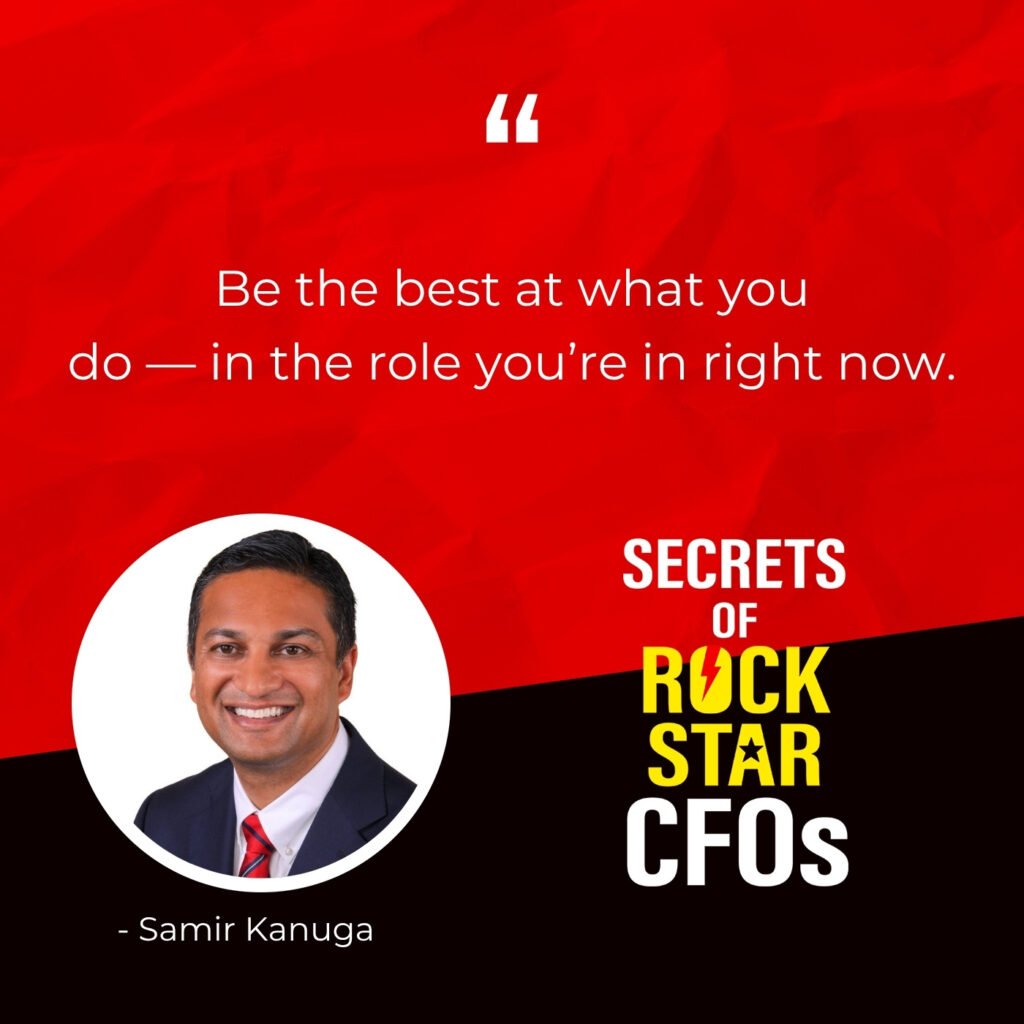
I would say be the best at anything that you’re doing in the role that you are in now. Be the best at it. I’ll give you an example. My first job was retail banking at Wells Fargo, and we had to send out International wires. I hated it at the time, but I studied it so much. Nobody liked it because there’s so much more nuance to sending an international wire, and I became good at it. I wanted to learn everything about retail banking.
Fast forward now, I had no idea but we’re a global company. We’re operating all over the world and we’re setting international wires all the time. I still help our team looking over the wire transfer D2 banking details and going through everything and making sure it’s accurate. I would say, be the best at what you’re doing in any role that you’re in. It doesn’t matter what it is. There’s always something to learn and those lessons will carry you forward. Somehow, the dots always connect.
That is fantastic advice. Samir, you’ve got a lot going on with three jobs and whatnot. I want to take a moment to thank you for making the time out of the ultra busy schedule that you’re living with to be here for our readers. With that, I like to give you the final word.
Thank you, Jack. It would be my honor to interview you one day. You’ve got such a great story career and I love for you to share that story and I appreciate everything you’ve done with CFOLC and grown into his massive organization that I take away a lot from. The second thing I’ll leave for all of our peers is, if you ever need a mentor or a sounding board or a piece of advice, reach out. I’m happy to always try to help the next generation of leaders.