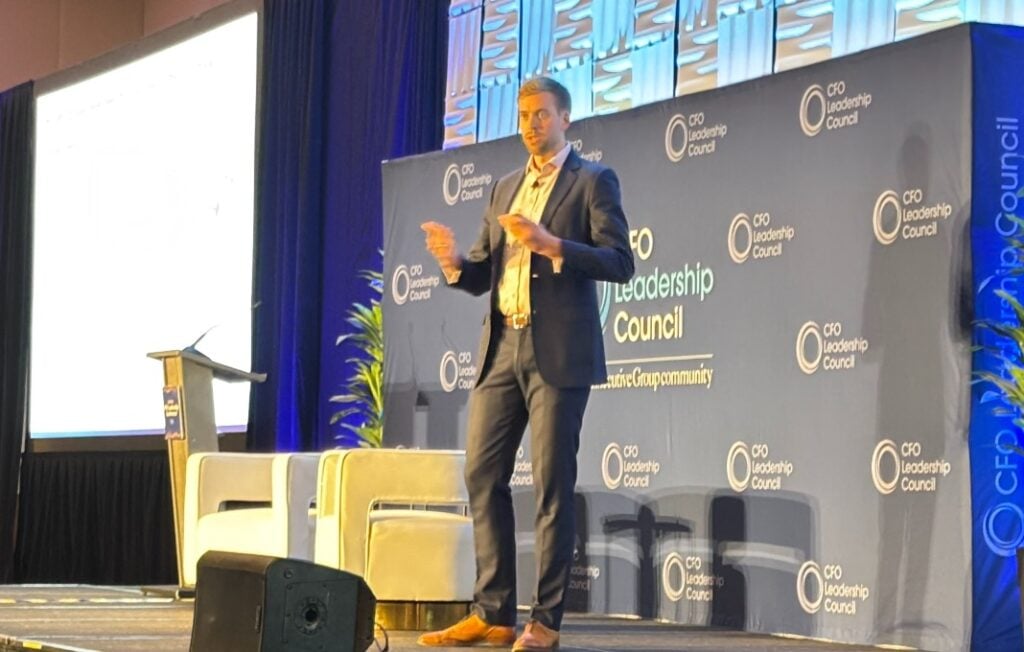
As a CFO with deep treasury experience, Joe Bertali sits at a unique intersection: He helps to oversee a company whose core product is moving money globally, while also managing his own firm’s liquidity and financial risk.
Bertali is CFO of PayQuicker, a fintech based in Rochester, New York, that specializes in cross-border payments. He shares how he manages compliance, insights into his treasury strategy and why it’s an “always-on” discipline.
How has leading a fintech changed the way you think about treasury strategy and what should more traditional CFOs understand about running treasury in a real-time payments environment?
In a real-time payments environment, you have to stay on top of things every day, which means having processes to check key metrics daily, strong visibility across the organization and very close relationships with your banks so you know things are under control.
We operate with daily KPIs and a platform and processes, built with our banking partners, that give us confidence in how funds are moving through the system, because when you’re moving money globally and quickly, the margin for error is small: If something goes wrong and people don’t get paid, that directly impacts them and our clients’ businesses.
For more traditional CFOs, the shift is moving from treating treasury as a periodic back‑office task to managing a live system in real time: You need infrastructure that lets you monitor flows continuously, rely on signals and exceptions instead of manually touching every transaction, and treat treasury as an always‑on discipline in a world where payments don’t wait for your month-end close.
PayQuicker operates across borders with anti-money-laundering obligations, evolving payment regulations and multiple banking partnerships to manage. As CFO, how do you define the boundary between your role and that of the chief compliance officer—and how do you make sure finance and compliance are genuinely aligned rather than siloed, especially as the company enters new markets?
I talk almost daily with our head of compliance, our head of banking and our development director, and every Monday we have a staff meeting where we’re talking cross‑functionally, so there really aren’t hard silos.
Compliance owns understanding and interpreting the regulatory requirements in each region, including anti-money laundering rules, Know Your Customer requirements and local payments rules, and making sure we meet those obligations. On the other hand, finance is responsible for ensuring the model works financially, managing liquidity and risk, and operating profitably within those constraints.
The place we most actively come together is in onboarding new partners and markets, where early collaboration between finance, compliance and banking is critical to understanding exactly how things will operate before launch. The goal is that when the flows start, everything runs smoothly from day one, because once the money is moving, it’s very hard to fix structural issues on the fly.
In that sense, we avoid silos through frequent communication, shared processes for new markets and a single, practical goal: get payments out fast, fix issues right away and do it all in a fully compliant way.
Your company has been rapidly growing, processing more payments across the globe than ever before. How did you build and adapt the finance function to support that pace of growth—and what financial infrastructure decisions proved most critical to sustaining it without outrunning your controls?
We engineered our company-wide processes and technology from the outset to handle significant increases in volume without having to re‑engineer everything each time we grow, so pulling in all those new payments didn’t require much additional effort. We already had the right processes, procedures and controls in place.
On the infrastructure side, we’re in the cloud on Microsoft Azure, which gives us the ability to take on hundreds of millions of dollars’ worth of payments and have the platform absorb it, so the most critical decisions were building scalable, cloud-based infrastructure and disciplined processes up front that allow us to sustain rapid growth without outrunning our controls.
PayQuicker has also been rapidly expanding into new verticals—clinical trials, the on-demand economy, HR/payroll and emerging markets—each with different regulatory and currency risk profiles. How do you evaluate and manage the financial risk of entering a new geography or vertical, and what frameworks have you put in place at the company to make those calls systematically?
For us, the foundation is a strong compliance department that understands the requirements in each region, so whenever we look at a new geography or market, compliance is front and center in our evaluation. The other key point is that we’re very selective about our partners: If we’re entering a new region of the globe, we only work with partners whose reputation, capabilities and understanding of local laws and regulations are truly top-notch.
Practically, the framework is cross‑functional and partner‑driven—compliance defines what’s required to operate safely, our banking and payments teams map out how the flows will work, and together we identify partners who can help us navigate the nationalistic barriers and complex rules you see in regions like parts of Asia or Latin America, while still remaining compliant and economical. We won’t flip the switch on a new geography or vertical until that combination of compliance clarity, partner quality and financial viability is in place.