
When was the last time you checked what your CFO skills are worth on the open market? New research shows you may be worth more than your paycheck suggests.
CFOs know that company performance doesn’t always reflect the work they’ve put in. When growth stalls or targets are missed, incentive compensation can suffer—even when the finance team has delivered meaningful results.
And even in a strong year, salary increases and bonuses may remain tied to arrangements established years earlier, without accounting for changes in the market or the demands of the role.
Chief Executive Group Research’s latest compensation study, based on internal data from 1,551 U.S. companies, reveals significant differences in what private businesses pay their finance chiefs, particularly as company size and performance change.
For CFOs, the findings raise a question worth examining: Does your compensation reflect the scope of the job you’re doing today—and the value you’re building for the future?
The $100 Million Divide
In 2025, the median private-company CFO earned $272,434 in total compensation, including a $217,234 base salary, $30,000 bonus and $25,200 in benefits and perks.
But the overall figure tells only part of the story.
At companies generating $50 million to $99.9 million in annual revenue, median CFO compensation reached $290,454. At businesses generating $100 million to $249.9 million, it jumped to $378,700.
By the time company revenue reached $250 million to $499.9 million, median CFO compensation climbed to $477,150—64 percent above the median at companies generating $50 million to $99.9 million.
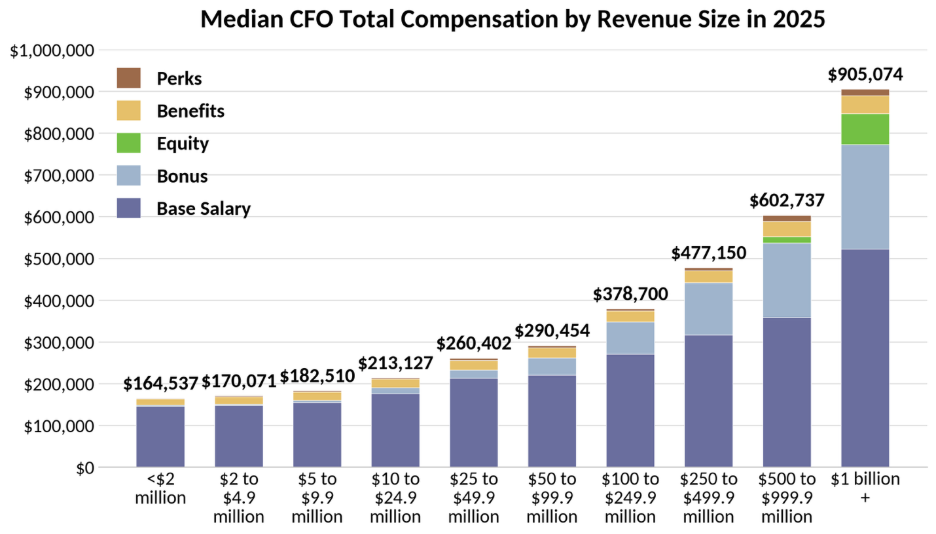
The differences reflect more than company revenue alone. Industry, ownership structure and geographic market all influence compensation.
Still, the pattern is clear: The market places substantially different values on CFO positions as businesses scale. That doesn’t mean a CFO should expect an automatic raise every time the company crosses a revenue threshold. But it does suggest that evaluating compensation solely against last year’s salary increase may miss an important change in the role’s market value.
The Bonus Opportunity Changes, Too
Base salary is only part of the equation.
In 2026, companies generating $100 million to $249.9 million in revenue expect to pay their CFOs a median $360,200 in salary and bonus combined. At businesses generating $250 million to $499.9 million, that figure reaches $476,011.
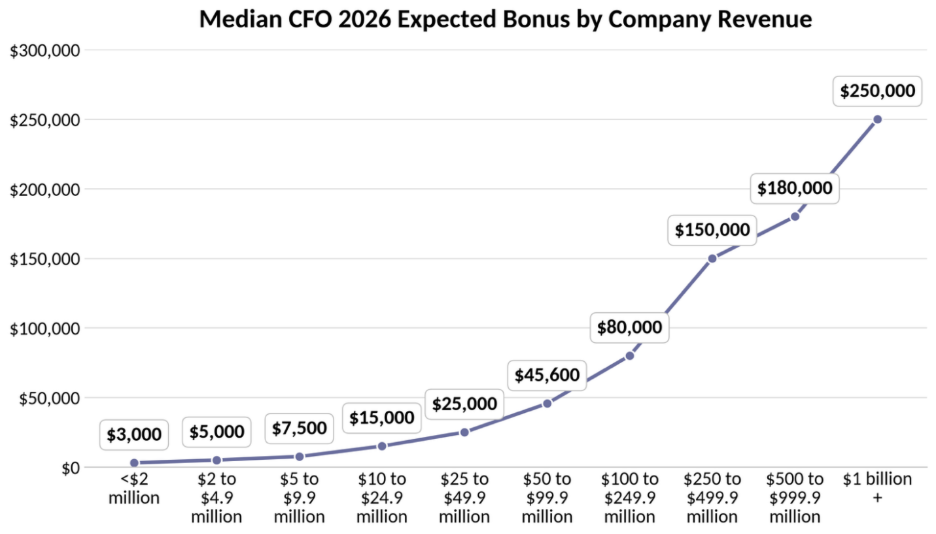
The difference in expected bonuses is particularly pronounced: $80,000 in the first group, compared with $150,000 in the second. For CFOs, that raises a question about how compensation opportunities evolve alongside the business.
As responsibilities expand, should more of the financial reward depend on achieving defined performance objectives? Are those objectives tied to outcomes the CFO can meaningfully influence? And does the potential upside reflect the complexity of the job?
A higher base salary provides certainty. A well-designed incentive program can recognize contributions that extend beyond routine financial management. The balance matters.
What Performance Is Worth
Company growth also influences the compensation picture.
Our research found that median CFO base salaries don’t vary nearly as dramatically with revenue growth rates as bonuses do. At companies reporting flat revenue in 2025, the median CFO bonus was $20,000. That increased to $30,000 at businesses growing between 5 and 9.9 percent, $36,500 at those growing between 10 and 19.9 percent, and $59,000 among companies reporting revenue growth of 20 percent or more.
At companies experiencing revenue declines of 20 percent or more, the median bonus was $7,500.
These figures don’t mean that faster growth automatically reflects better CFO performance. Market conditions, industry dynamics and decisions made across the leadership team all contribute to company results.
Nor does every CFO have the same mandate. One may be focused on funding expansion. Another may be charged with improving working capital, strengthening margins, integrating acquisitions or preparing a business for sale.
But the differences suggest that companies often use variable compensation to distinguish financial outcomes, even when base salaries are comparatively similar.
For CFOs evaluating their own arrangements, the relevant question isn’t simply whether the bonus is competitive. It’s whether the incentive measures reflect the responsibilities and outcomes they’re accountable for delivering.
Are You Being Paid for the Job You Have Today?
Consider what your position looked like when you accepted it: How large was the company? How complex were its financing needs? How many people reported to you? What decisions were you responsible for making?
Now consider the position you’re performing today.
Perhaps you’ve helped the company double revenue, expand internationally, introduce a new operating model or complete multiple acquisitions. The title may be unchanged. The job likely isn’t.
This is where benchmarking becomes particularly useful. Rather than approaching compensation discussions around tenure, inflation or a general desire for a raise, CFOs can use market data to evaluate how the position compares with similar roles at businesses of comparable size and complexity.
That includes understanding the full package—not just salary, but annual incentives, long-term rewards and benefits. It also means looking at a range of compensation outcomes rather than a single median. The appropriate market position may differ based on the CFO’s experience, responsibilities and contribution.
Making the Business Case
CFOs routinely evaluate investments based on their expected returns. Compensation discussions can benefit from the same discipline.
If responsibilities have expanded, what has changed? Which financial or operational outcomes has the CFO helped deliver? What new capabilities does the business require? And how does compensation compare with positions involving similar expectations?
These questions create a more useful foundation for discussing pay than simply pointing to a higher market average. They also help distinguish between compensation for performing the current role and rewards for delivering exceptional results.
A CFO who has assumed responsibility for acquisitions, financing strategy or a major transformation may have a stronger case for reassessing the compensation structure itself—not simply increasing base salary. That might mean revisiting performance measures, bonus opportunities or longer-term incentives.
Ultimately, compensation should reflect both the demands of the position and the value of the outcomes the company expects its CFO to deliver.
Know Your Market Value
Compensation isn’t the only consideration in a CFO’s career. A strong relationship with the CEO, influence over strategic decisions, opportunities for professional growth and the chance to help build a successful business can all make a position rewarding.
But understanding market compensation remains important, even for finance chiefs who have no intention of leaving. The point isn’t to turn every annual review into a negotiation. But it is to make sure the company’s understanding of the CFO role has evolved alongside the business itself. Because if the organization has grown, the responsibilities have expanded and the expectations have changed, one question deserves a fresh look: Has the compensation kept up?
For more benchmarks by company size, industry and ownership structure, explore Chief Executive Group Research’s latest CEO & Senior Executive Compensation Report.